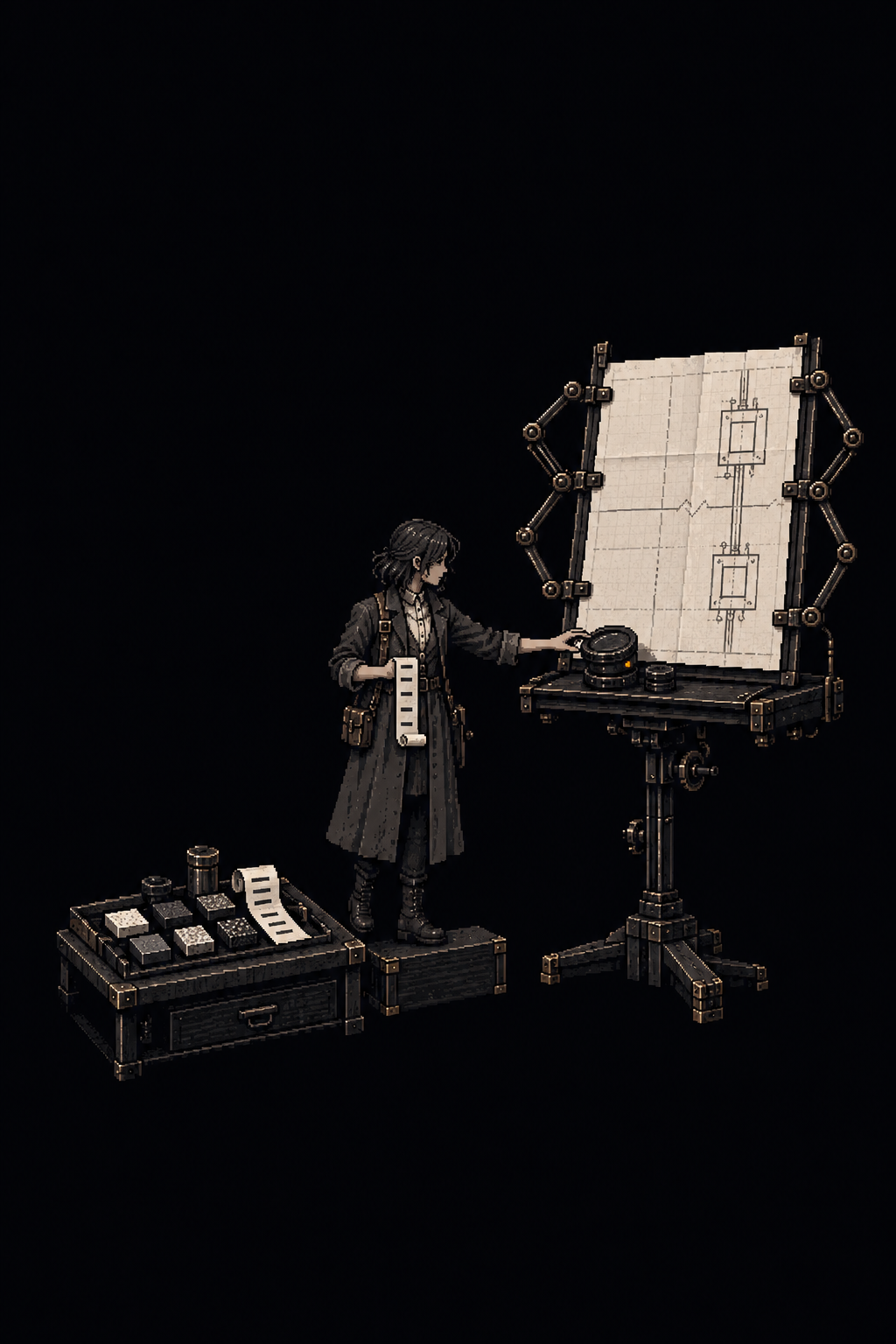
Select evidence with its required context
A small inspection packet must preserve what makes its observations interpretable.

A tiny crop can show an arrowhead clearly while omitting the note it belongs to. Another crop can preserve the note but lose the legend that defines its symbol. Reducing the amount of image material does not necessarily reduce the work required to interpret it correctly.
WITNESS is a proposed instrument for inspecting drawing evidence. Its workflow treats an observation and its required context as a unit of selection. The surviving kernel includes a bounded selector that accounts for shared dependencies. It also includes separate verification for narrow image-connectivity certificates. Those are implemented components within a larger proposed instrument, whose real-drawing performance remains unvalidated.
The design begins with competing interpretations and asks which acquired evidence distinguishes them. A prospective crop can be expected to help, but expectation is not established coverage. The selected packet should say which distinctions were actually supported and which remain unresolved.
An illustrative packet with shared context
Suppose three interpretations remain for a drawing note: it applies to feature A, feature B, or the view generally. Three candidate pairs need distinguishing. An endpoint inspection and a note inspection may each distinguish some pairs, while both require the same legend to make their observations meaningful.
Assign illustrative costs to make the selection concrete. The legend costs three units to acquire and inspect. Each of the two inspections costs two units. Together, their dependency-complete packet costs seven units because the shared legend is included once, while a separate overview costing ten units might cover the same declared distinctions without being preferable under this budget, provided both alternatives carry validated coverage labels.
The costs here are teaching values, not a WITNESS performance measurement. They can represent a chosen resource budget, provided the workflow defines the units consistently. If actual acquisition requires decoding a larger source before producing a small crop, that prerequisite work belongs in the cost calculation.
The kernel’s selector evaluates newly covered distinctions against the additional cost of the item and its dependencies. It chooses greedily and then removes redundant selected roots. This method does not establish a globally smallest packet, and a failure to complete coverage within the budget does not prove that no better selection exists.
Check what the coverage labels mean
The selector accepts supplied coverage information. It does not independently decide that an arrowhead resolves an engineering question. The caller must validate the distinction before counting it as established. Otherwise the optimization can faithfully organize unsupported labels and return a compact packet whose apparent completeness exceeds its evidence, even though every dependency has been included and every arithmetic step in the selection procedure has been performed exactly as specified.
Candidate coverage also depends on the candidate set. Distinguishing A, B, and a general note does not prove that the correct interpretation was included. A fourth possibility may remain unconsidered. Preserve the unresolved option and review the candidate set when the observations do not fit any proposed explanation.
Dependencies should be explicit and checked. A missing legend reference makes the packet incomplete. A circular dependency can prevent a coherent acquisition order. The recovered selector detects dependency cycles, which is useful precisely because the caller’s evidence description can be malformed even when the underlying image operation is correct.
Preserve enough information for another check
For a narrow connectivity claim, retain the source identity, original samples, masks, endpoints, neighborhood rule, and certificate. Another verifier can then check the returned path or closed reached region without trusting the prose description of the result. Keep the diagnostic crop’s coordinates tied to the original source so a reviewer can locate the same region.
Reproducibility has several levels here. A verifier may reproduce the image predicate from supplied masks. Reconstructing those masks requires the original samples and thresholds. Reconstructing the samples from a PDF requires decoding and rendering behavior beyond the current kernel’s complete capabilities, so the packet should state which reproduction level it supports and identify any upstream transformation that a second reviewer would have to verify separately.
A mathematically valid certificate can still belong to the wrong crop. Source identity and coordinate transforms therefore need acceptance checks alongside the certificate verifier. Deliberately substitute another source version or shift the endpoint coordinates in a test packet. The validation should reject the mismatch or produce a different, accurately scoped result.
For the illustrative three-candidate question, the final packet should identify the two acquired inspections and the shared legend, record their actual cost, and show which candidate pairs the evidence distinguishes. Attach any narrow certificates to the observations they verify. If one required distinction remains unsupported, retain that missing distinction in the packet rather than describing the collection as sufficient for a final interpretation.
Source notes
Based on the WITNESS proposal and recovered evidence-selection and certificate code. Packet costs and the three-candidate scenario are illustrative. The selector is greedy, and real-drawing interpretation has not been validated.