The table that changed when the character moved
The Robins adaptation connected stable scenery, exact source words and audience understanding.
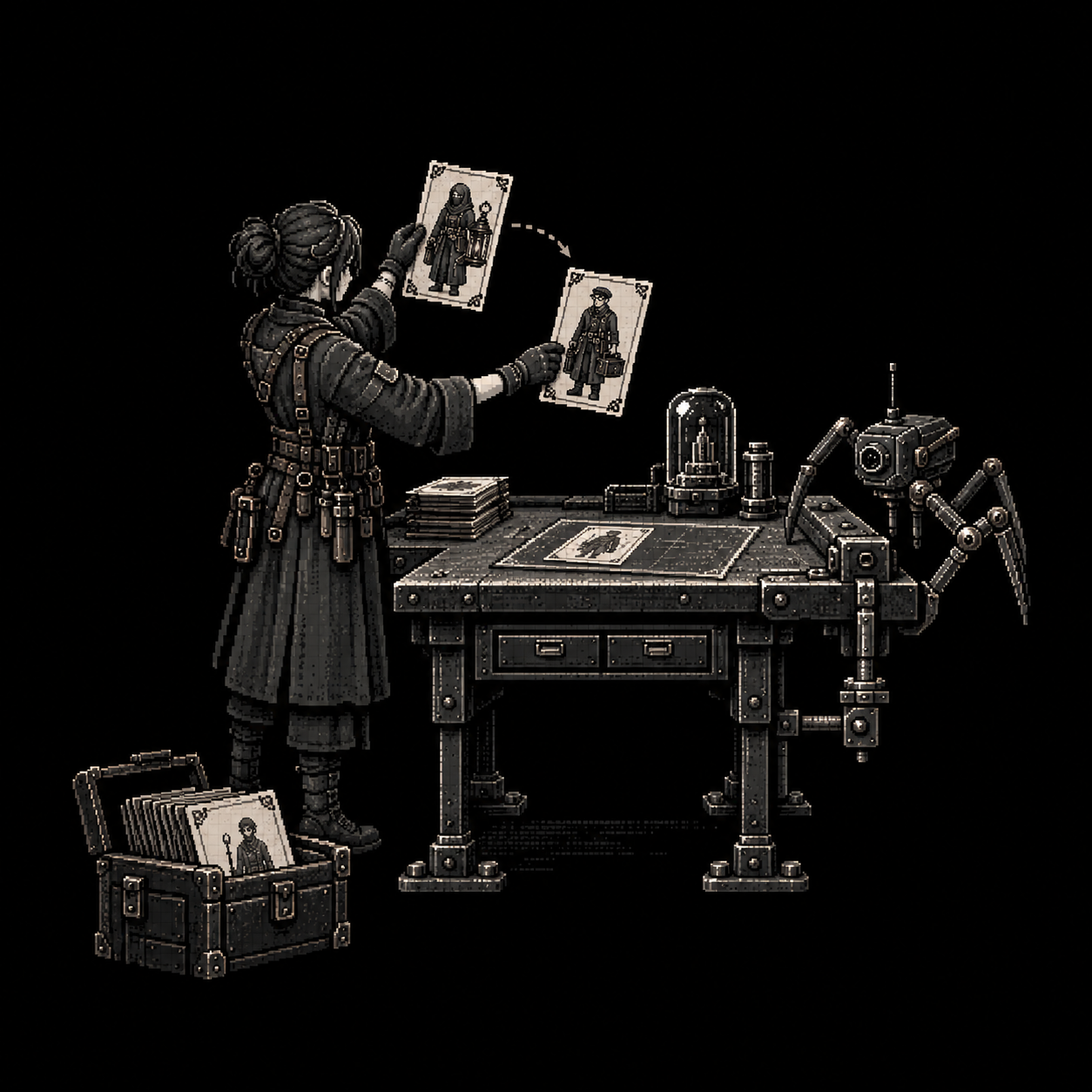
The table should have stayed the same when Joseph changed pose. Instead, pieces of the furniture appeared inside replacement character drawings. An action that should have changed the man could change the room around him.
A Flock of Robins was a larger test than the early shorts. I asked for the book to be adapted from beginning to ending, initially as twelve two-minute films. Codex extracted the manuscript, retained its identity and selected exact narrative and spoken passages.
The first Part One compressed a library, dream, parcel, map and departure into its opening. The file rendered, and the source words could be checked. I rejected the result. Events moved too quickly, objects were out of scale, and text still seemed to sit over the picture. A journal had become 1.8 metres wide.
The audience needed more than motion
The adaptation expanded to twenty-four parts, with a calibration scene giving ordinary dimensions to a journal, a table and a standing figure, and a generated journal spread placing source words onto its paper surface.
The next opening became quieter but lost necessary information. Joseph repeated small paper actions and seemed to fall asleep. The manuscript concerned a dream from the previous night. Without his private thoughts, a viewer could not understand his dissatisfaction or read the transition correctly.
I asked for those thoughts back, using the manuscript’s words. Joseph should remain awake, follow a particular sheet through the scene and open his journal for a reason. An action could carry information, but a tired posture could not communicate every fact the audience needed.
The retained craft standard puts the viewing question plainly:
Read the source passage and identify the section's beginning condition, consequential action and ending condition. Decide what the viewer must learn, what enriches that action and what can be omitted. Do not call every source paragraph necessary merely because it appears in the book. Do not replace omitted source speech with invented dialogue.

Assume the audience has never read the book or the treatment. For every shot, record what the viewer knows at its start, what the action or words add, and how the resulting knowledge supports the next shot. Distinguish a mystery the story intends from missing context that prevents the viewer from following an action.
Public source excerpt. Repository snapshot, requiring repository access.
Those are historical staging instructions. They establish a requirement to decide what the audience must learn, rather than treating quotation accuracy or a moving camera as enough by themselves.
One room, through every pose
R4 restored thoughts and actions, then departed from the approved construction by projecting a finished room picture across floor and wall geometry and scaling some seated drawings differently across their width and height. Furniture fragments changed along with Joseph.
The result could pass local checks while failing a settled requirement. A table needed one identity, one scale and a position independent of the actor’s current drawing. A close view needed to come from the shared scene. Similar-looking images were not sufficient continuity.
R5 rebuilt the room with separately placed furniture and proportional whole drawings. Its 135-second review copy retained exact thoughts, a packed editable scene and the complete rendered sequence. It still lacked the two full audiovisual reviews required by the revised craft standard.
I explicitly authorized posting that review copy after the missing review had been disclosed. Publication and acceptance were separate decisions. The notebook kept the earlier rejected cut alongside the later candidate.
Further revisions expanded camera and narrative choices, but full viewing remained unfinished in the retained record. The larger lesson belonged to this particular adaptation: exact words must give the viewer usable knowledge, and the objects carrying the action must remain themselves.
The stable table and the restored thoughts solved related problems. One kept the physical event coherent. The other made its meaning available to someone who had never read the book. The next performance still had to demonstrate both in motion.