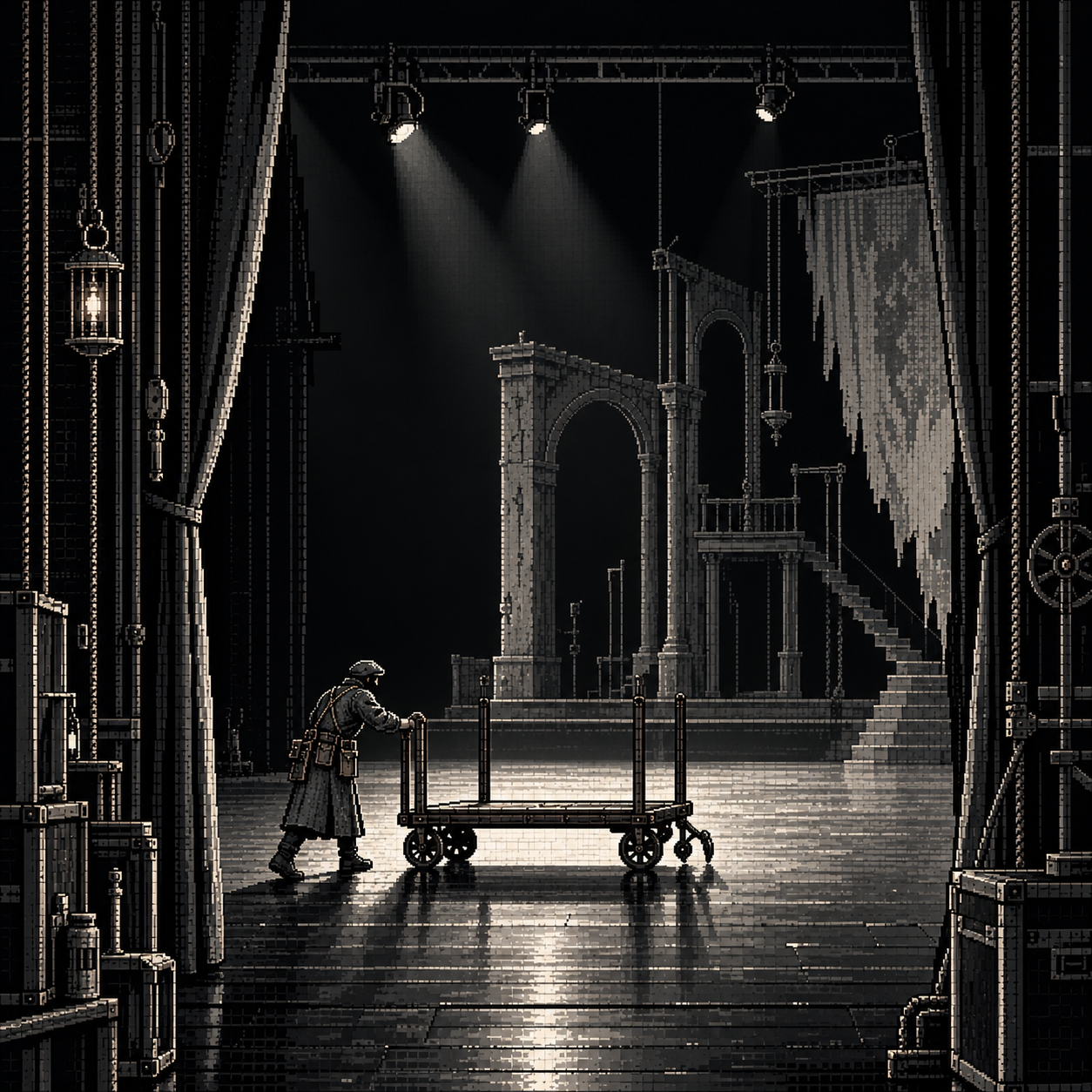
Making the curtains ordinary again
Simpler stage machinery repaired the curtain route and kept the wispy hands small.
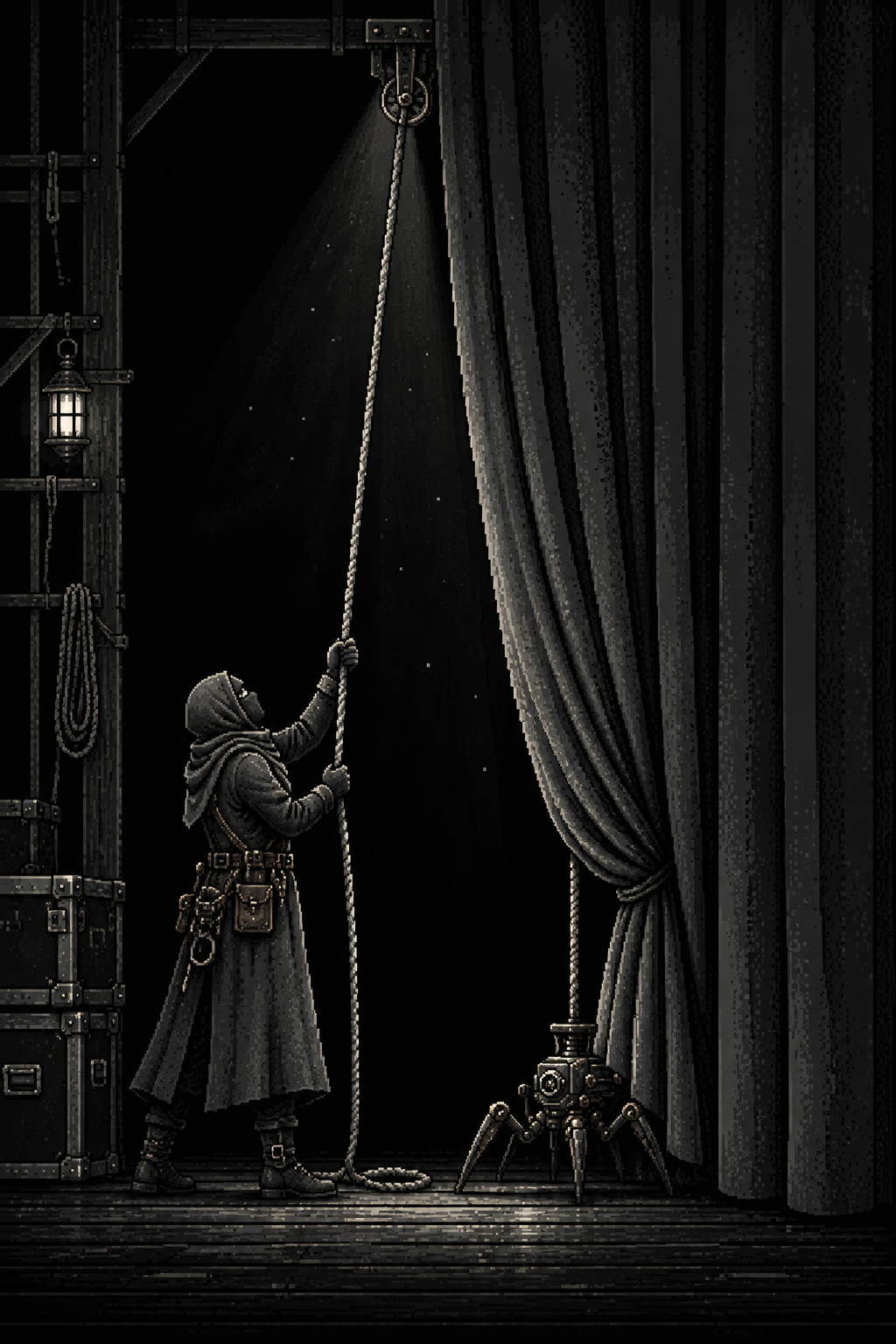
The pulleys were too large, and the rope route had become an obstacle to the people meant to operate it. The mechanism was accumulating detail while the curtain still lacked a reliable opening and return.
I had requested half-size shadow stagehands, wispy and simple. Two would handle the carts and two the curtain ropes. Their pads needed to meet the equipment. The hands and their motion should remain subordinate to the stage.
The earlier construction tried segmented rope bodies, guide joints, frictional strokes and changing winch arrangements. Rope segments escaped pulley planes. Guides interfered with collisions. Low routes obstructed the cart operators. More solver detail did not settle the mechanism’s scale or usefulness.
I accepted slight stiffness in this flat theatre and asked for conventional equipment. The repair used the overhead traveller, 120-millimetre sheaves and six-millimetre cord hauled from the wings. Hundreds of segmented rope bodies and their raceways left the active construction.
Be exact about the simplification
The retained repair record states the method directly:
The acting floor is clear. Curtains use the overhead traveller track, 120 mm sheaves and 6 mm cord. Two shadow hands haul the cord from the wings. The model treats the cord as an ideal transmission: hauling cues drive physical travellers, while the fabric responds to gravity and collisions. Flexible cord forces are not simulated.
Public source excerpt. Repository snapshot, requiring repository access.
The cord is an ideal transmission in this model. Its hauling cues drive the physical travellers, while the curtain fabric still responds to gravity and collision. That is a defined approximation, rather than a claim to simulate every flexible force in the rope.
The cart route kept actual pad-to-handle contacts. Eased movement and small body leans showed preparation, effort, braking and return. The hands did not need to grow or acquire elaborate anatomy to make those phases visible.
The curtain also exposed a weakness in the checks, because carrier positions and broad fabric height could pass while a rendered view showed the inner lower edges still apart where the opening should close. The useful correction changed the fabric response and measured the actual inner hems. An earlier helper had selected an outer hem instead.
The check needed to point at the opening the audience would see. A nearby piece of healthy geometry could not answer that question.
Equipment belongs to one system
The stagehand wisps required their own repair. One pass reported completion without producing cache files because the relevant fluid calculation was disabled. A later route used smaller domains and one source per operator. The black lower-body gas interacted with the deck and surrounding building, while thin moving carts and props stayed outside that particular calculation.
The office inventory added six painted shallow objects: a window wall, meeting-room wall, workstation, plant, sofa and whiteboard. Each had a support, mass and known wing storage. Loaded carts brought them onstage and returned them.
Permanent cameras supplied another shared boundary. Their bodies, mounts, positions, lenses and travel bounds were recorded, and later authorized placement changes moved the equipment and its mount together, preserving the physical identity that a renamed floating camera could not supply.
The repaired rehearsal showed a clear deck, visible handles, loaded entry, returned scenery and closure. Earlier unsuccessful recordings remained available as diagnostics.
The result was a simpler operating construction with better-defined tests. Ordinary scale, physical storage and exact contact points did more useful work than another layer of invented machinery. The next actor would have to meet the same standard: look coherent, remain attached and move through a reachable physical method.