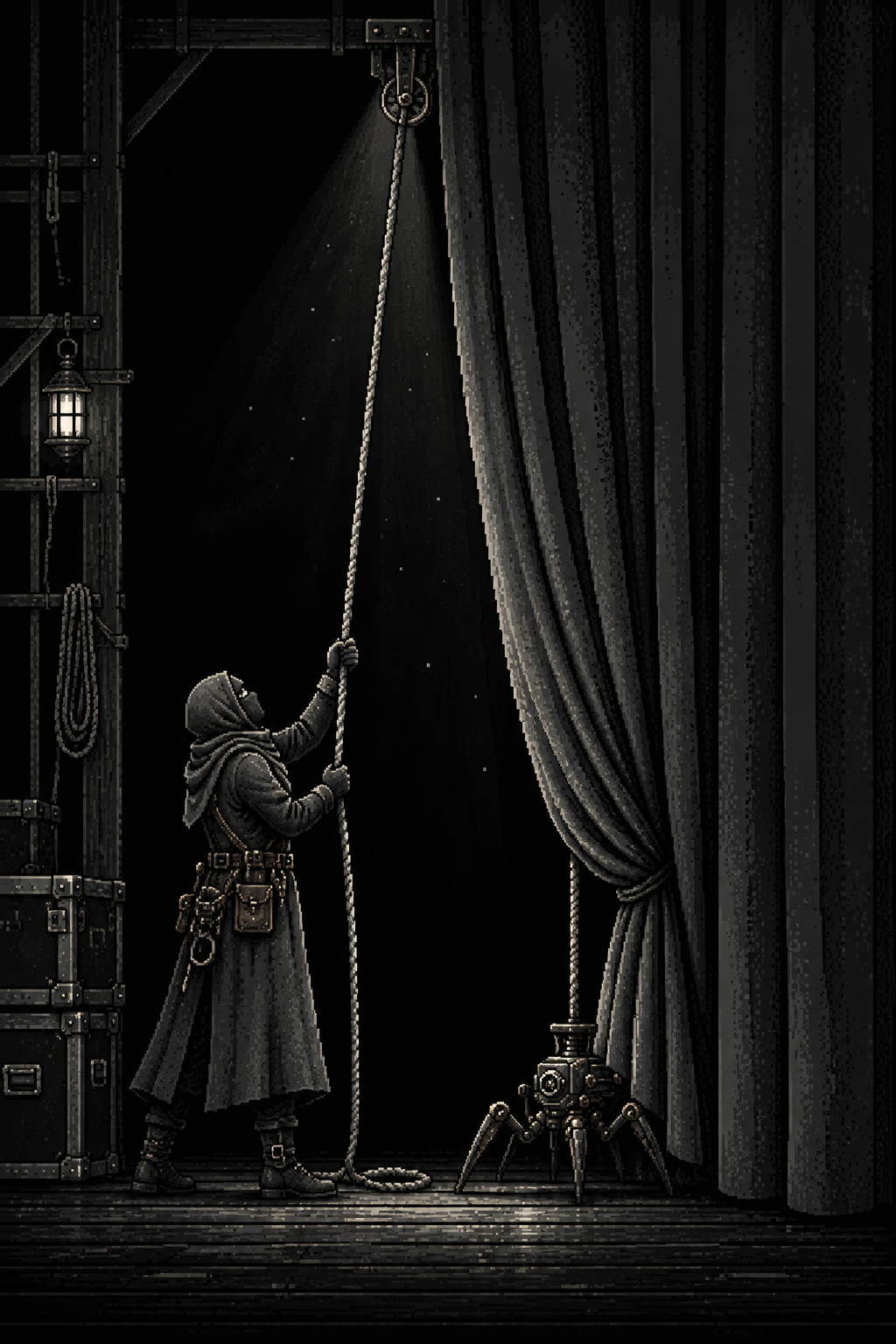
Joseph loses the wires
Joseph became an accepted rod puppet through corrections to the drawing, joints and operator's reach.
Joseph could remain attached and still move badly. The first wire-operated versions made that problem visible: folded knees after travel, legs lifting backward and a torso that could yaw.
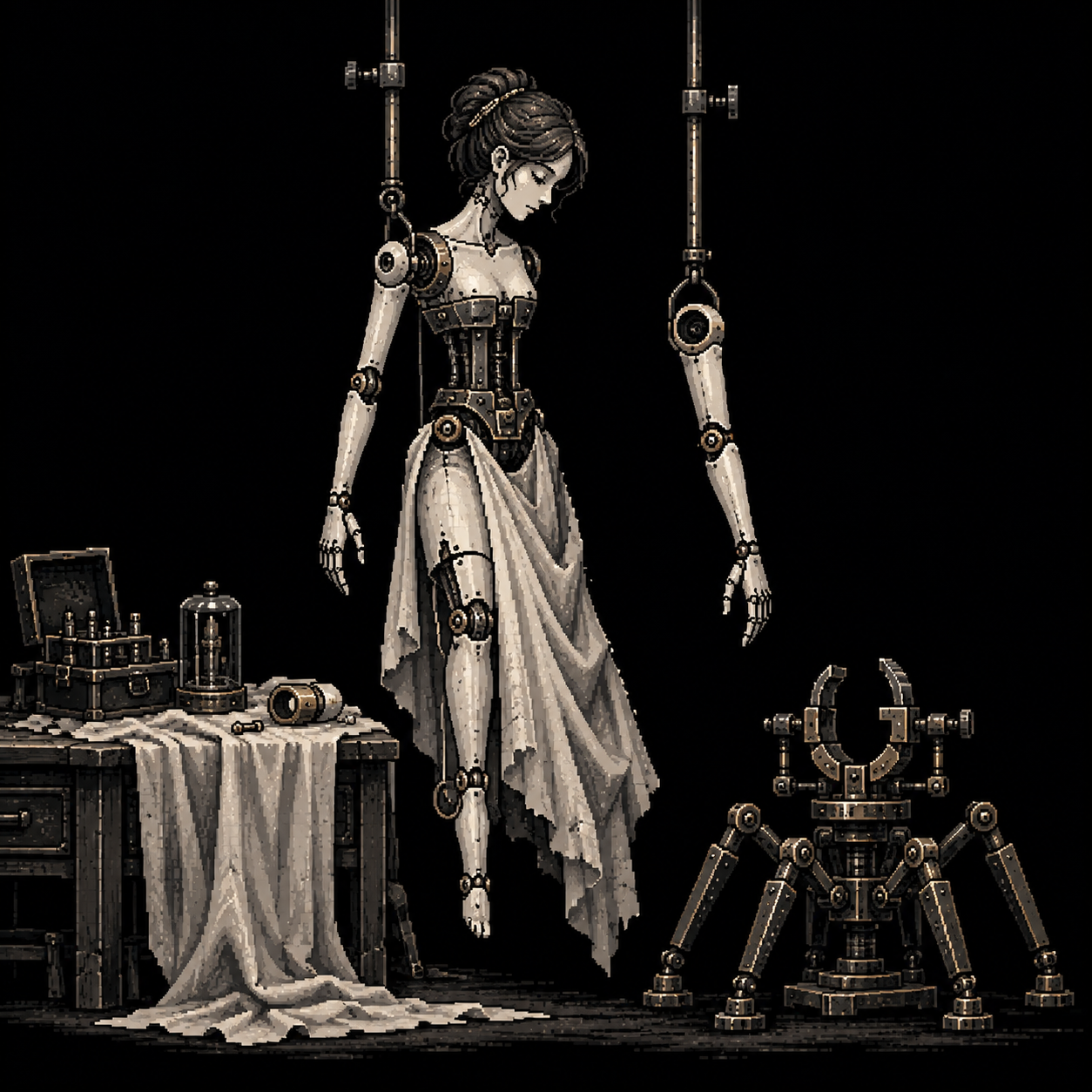
The proposed figure began with separate head, torso and limbs, controlled from above. Codex tried rigid links and ideal spring-like transmissions. I rejected the generic geometric appearance. The painted Recluse finish had not been waived because the work concerned mechanics.
Grayscale pixel artwork repaired the appearance. The silhouettes became solid painted plates, but the new surface did not make the walk convincing. I also challenged the spring shortcut. Segmented wires added mass and gravity, then produced their own route and movement problems.
Research into Thai puppetry helped distinguish different constructions and handling traditions. It did not supply universal numerical stops for the joints. A described gesture could inform an adaptation without becoming an invented mechanical law.
Change the construction
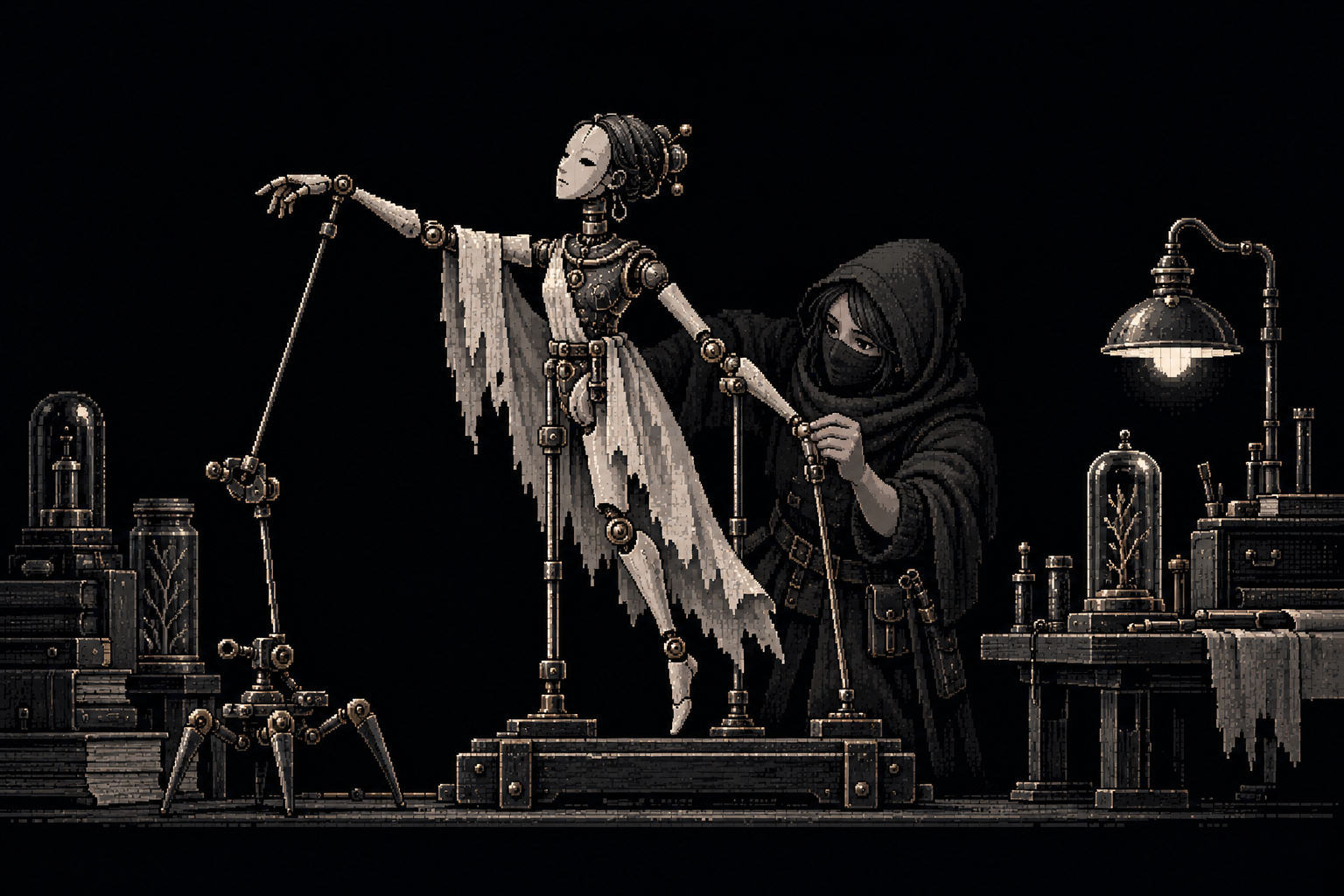
I replaced the wire-operated candidate with a rod-operated Joseph. A continuous head-and-body plate kept his identity together. One separate arm moved at shoulder, elbow and wrist. A central wooden rod supported the body; another rod fastened to the hand. One small shadow operator worked from behind.
The simpler figure still needed corrections. A laughter gesture covered the eyes. A loose swivel let the palm turn the wrong way. The moving hand was too large, and the arm’s hanging position did not match the fixed painting.
Codex secured the hand rod, corrected the proportions and authored reachable paths without weakening the attachment threshold. The painted fingertip, not merely the rod grip, had to approach the mouth in a way the audience could read.
The operator’s body mattered too. I required it to move rather than lengthen its arms. Both straight arms stayed 340 millimetres long while the operator followed the two grip positions, preserving the fixed places where its pads met the rods by moving its body to reach them.
Keep the accepted edition
The resulting eighteen-second rehearsal performed speaking, laughter, anger, crying, strike preparation and recovery, and a carried crossing. Joseph’s legs were fixed parts of the body painting. The crossing was carried movement; it was not a hidden walking mechanism.
The physical check covered all 1,728 native frames. Plates stayed above the solid deck, and the largest joint gap was 2.649 millimetres, beneath the unchanged three-millimetre limit. The recorded pictures were inspected in ordered sheets, and the complete movie decoded.
My acceptance was retained with the actual assets:
  "user_statement": "I really like it. Well done, save all that information for repeatability.",
  "actor": "Joseph rod puppet",
  "accepted_scene": "joseph-accepted.blend",
  "accepted_recording": "joseph-rod-test.mp4",
Public source excerpt. Repository snapshot, requiring repository access.
Those fields record my acceptance and the frozen scene and movie names. They establish this particular accepted puppet test. They do not stand in for a later combined performance or a new whole-film viewing pass.
The source paintings, construction recipes, cached scene, selected views and verification records were kept together, while the earlier wire versions remained retired diagnostics that could be distinguished from the accepted method they had preceded.
Joseph’s result was useful because it narrowed the recurring job. A future film should start with his existing painted plates, two rods and reachable vocabulary. It should spend its time choosing what those gestures mean in the script, rather than quietly rebuilding the actor whose construction had already been accepted.