Fosi SK01 review — tone controls and headphone loads
Twelve firsthand written accounts examine the SK01's practical tone controls, headphone-dependent output limits and conflicting USB-noise experiences.
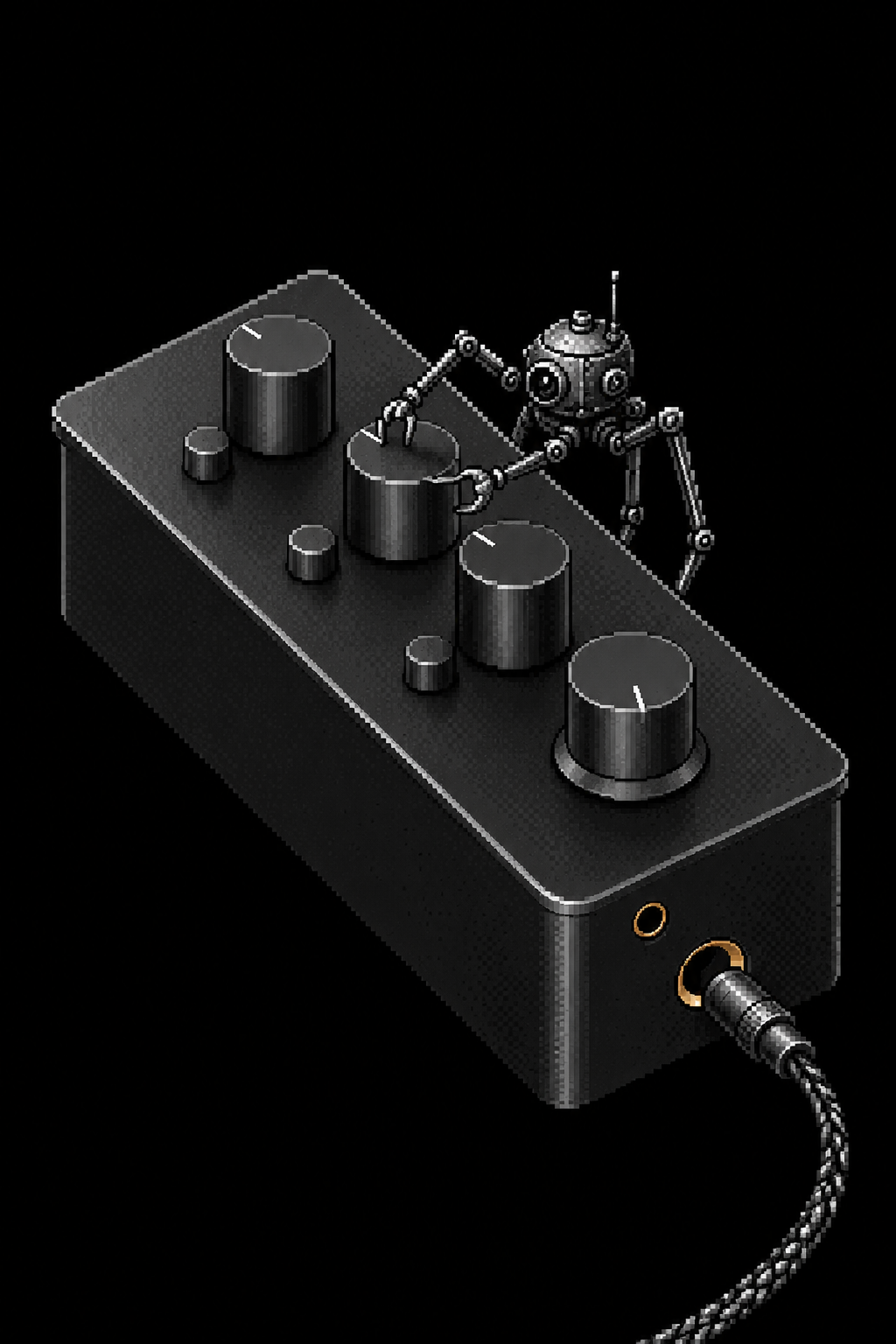
A bass adjustment is easier to make when the knob is beside the headphones. The Fosi SK01 puts three tone controls and a volume knob on a narrow metal box, ready to change an analog signal without opening an equalizer window. The appeal is immediate. The amount of clean output available for a particular headphone takes more investigation.
Twelve firsthand written accounts support the usefulness of those controls while exposing limits that the headline power rating cannot settle. Source voltage, headphone load and USB power conditions change what the owners actually obtained.
Scope and exact component
This literature review concerns the Fosi SK01, catalog ID 302ddf7d798f62686738, with originals inspected on 26 October 2026. Four longer reviews and eight independent owner accounts qualify. Two of the owner records concern actual physical inspection or modification rather than a listening comparison. They support those narrow actions, not an expanded claim of twelve laboratory or listening tests. Several forum dates remain unresolved.
Drew has not operated, opened or listened to the SK01. Amir Majidimehr received a Fosi sample. Shammi Dang describes purchasing a unit. The iXBT article labels commercial marketplace links; its sample arrangement remains unknown. Other incentives remain unknown where unstated. Follow-ups by one author form one record, and question-only or theory-only comments do not qualify.
Fosi’s specifications identify a 3.5 mm analog input, line output, 3.5 mm and 6.35 mm headphone sockets, and USB-C power. This is an analog amplifier and preamp; USB-C supplies power rather than acting as a digital audio input. Fosi rates high-gain output at 2,400 mW into 32 ohms and low gain at 300 mW into 32 ohms. Those factory figures remain distinct from independently observed output limits.
The strongest result is an accessible adjustment
Shammi Dang used a laptop, a DDHiFi dongle and 50-ohm Sennheiser HD599 headphones on low gain. Dang found comfortable volume and useful tone changes. A later follow-up describes infrequent use and continued adjustment of the tone controls, without adopting the loudness setting.
Gmc8538 fed the SK01 from a microphone’s monitor output into 80-ohm Beyerdynamic DT990 Pro headphones. The owner obtained more usable volume and preferred added bass with reduced treble for games and films. The source connection matters: improving a weak monitor feed does not measure the amplifier’s maximum clean output.
ZeroFourBC used it with Moondrop PARA headphones and valued the convenient bass adjustment. These reports converge around a physical task that software can make awkward across several sources. Their agreement concerns changing a preference quickly, without establishing a common frequency response or a universal improvement in fidelity.
A demanding headphone changes the verdict
Amir Majidimehr measured and listened to the SK01. His bench account reports 140 mW into 300 ohms and poor channel matching. During listening, the low-impedance Dan Clark Audio Stealth provoked cutouts at a modest setting, while the Sennheiser HD650 worked more satisfactorily and responded usefully to the bass and loudness controls.
That difference is more informative than assigning the amplifier a single adjective such as powerful. Headphone impedance describes the electrical load, while sensitivity describes how much sound results from the supplied signal. Neither a large watt figure at one load nor a high volume-knob position predicts every headphone’s behavior.
conspibro described limited headroom with a Sundara, using a laptop headphone output and negative preamp adjustment in EQ. The SK01 required more knob travel than a U3 mini in that account. The upstream signal level and gain were not calibrated, so the knob positions cannot be converted into an output-power comparison. They still document a real limit in that owner’s chain.
Tone boost can use up the available margin
Djano placed the SK01 before a BT30D Pro, using its bass control to improve the relationship between speakers and passive subwoofers. Later comparisons involving a computer output and X2HR headphones prompted corrections to an early input-headroom concern. The comparison lacked a calibrated signal level, and the initial concern should not become a settled electrical diagnosis.
kzndenis reported roughly five hours and forty minutes of high-volume battery use. Tests through an older Creative sound card showed a nearly flat bypass response, while a strong middle-frequency boost produced audible distortion. The writer acknowledged limitations in that measurement route. The result supports checking the entire boosted signal chain, rather than treating that sound-card trial as a precise amplifier distortion limit.
Neither Djano’s description of loudness behavior nor a response curve at one volume setting establishes how the circuit behaves across all volume positions. Broad tonal convenience and accurately characterized loudness compensation are different claims.
USB noise remains a conflict
alex_neri reported a high-pitched noise on USB power with some headphones below 80 ohms, despite trying several cables, chargers and outlets. The same writer liked battery-powered portable use. Follow-ups in another discussion belong to this one source record, rather than supplying an extra vote.
Background-Boat-9238 later confirmed actual stationary desk use in that thread and reported no hiss. The original question concerned DT990 compatibility, but the later reply does not establish which headphone was attached. The quiet desk and noisy USB reports therefore remain a conflict with missing conditions; neither proves that every unit is noisy or that changing a charger will fix it.
Majidimehr also found the battery empty after leaving the unit on overnight; charging restored operation. That observation and the iXBT runtime test describe different durations and settings, so they cannot establish contradictory battery capacities.
Preamp use and physical access need separate evidence
Steva found the headphone output stronger than the line output when driving a power amplifier and valued the preamp tone controls. Dang’s brief trials through Norge and Cambridge integrated amplifiers were less pleasing than the direct connections. The downstream gain arrangements differed, and neither account supplies a controlled comparison of identical signal levels.
GGroch removed the bottom and three tone knobs, while the volume knob resisted removal. The partial view challenged a speculative circuit-board identification. Bruce Morgen later described a modified SK01 with the battery removed and an external converter, reporting difficult enclosure work and no audible noise during an open-case check. That altered unit cannot establish stock-unit noise or longevity, and the account does not establish why a battery would fail.
These inspection records clarify what the writers physically encountered. They are not instructions to modify the amplifier, and they do not replace missing long-term stock-unit tests.
Current price and a controlled next test
On 26 October 2026, Bloom Audio listed the SK01 in New condition at US$79.99, marked in stock for immediate shipping with Add to cart enabled. This is a native USD retailer price, excluding destination tax and shipping; no conversion was required.
A useful next test would hold the analog input voltage, gain and headphone constant, compare battery and USB operation, then repeat with tone bypass and defined boosts. Clean output before cutout, low-volume channel balance and audible noise would be recorded separately. That controlled test has not been performed for this review.
The SK01 has evidence for a modest, specific job: accessible tonal adjustment after an analog source. Before a demanding headphone is assigned to it, the unresolved question is the clean level available with that source, those settings and that electrical load.
The twelve firsthand records
- Amir Majidimehr / amirm — bench results, Stealth and HD650 listening, overnight battery observation; 19 November 2023
- Djano — tone controls in a speaker/subwoofer chain and corrected follow-ups; post 1711774 and same-author amendments
- kzndenis — runtime and sound-card tests with stated limits; 22 October 2024
- Shammi Dang — HD599 use and integrated-amplifier comparisons; 10 June 2024, follow-up 31 October 2024
- GGroch — actual enclosure and knob inspection; post 1722171
- conspibro — laptop source, Sundara and EQ headroom; posts 1767129 and 1767667 counted once
- Steva — line-output and headphone-output comparison in actual preamp use; post 1780103
- Gmc8538 — microphone monitor output into DT990 Pro 80-ohm headphones; 17 October 2024
- alex_neri — USB noise and battery use; independent author locator, follow-ups merged
- ZeroFourBC — Moondrop PARA use and accessible bass control; author locator
- Background-Boat-9238 — later confirmed desk use without hiss; independent comment locator
- Bruce Morgen — modified-unit enclosure and converter account; post 2451398