Why abandoned places can permit freedom as well as fear
Ruins test the limits of liminal horror by showing how the loss of an official purpose can create other uses, memories, and claims.
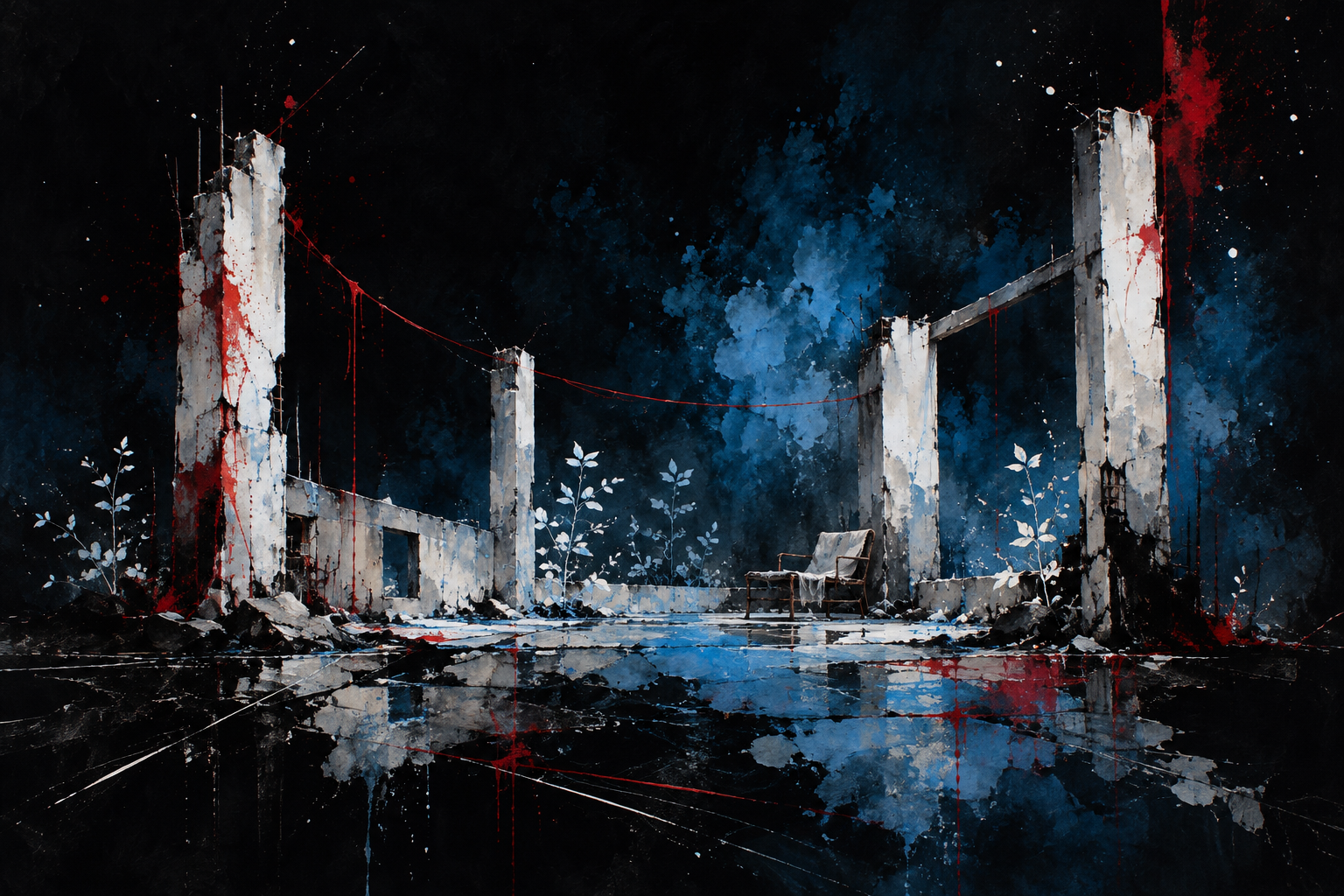
A factory stops producing, its roof begins to fail, and the official account of the site records closure, an ending that may be decisive for the people who lost work and the households that depended on their wages. It does not establish that everything else happening there has ended, or that every subsequent encounter with the place is an encounter with fear.
Industrial ruins are a useful test for a theory that links familiar environments with failed passage. The building’s purpose has changed or disappeared, yet the withdrawal of one set of rules can permit other activities. A theory needs enough precision to recognize those possibilities alongside damage, loss, and continuing constraint.
Scope note: the discussion concerns interpretations and records of ruined places. It offers no recommendation to enter unsafe or restricted sites, and it distinguishes documenting a place from deciding its future use.
A former purpose is not the only purpose
In Industrial Ruins, Tim Edensor examines material, sensory, and practical possibilities in spaces that have escaped some of their earlier regulation. His account makes room for play, alternative use, memory, and ecological change. Those possibilities complicate the assumption that an abandoned building is necessarily an empty building.
I take the complication seriously because a photograph can make decay appear complete while excluding the people who still use, remember, or maintain the site. The image records a selected view. It cannot settle ownership, contamination, informal activity, or the social consequences of closure without further evidence.
That is also a reason to qualify an optimistic reading. An activity enabled by the loss of formal control may depend on another person’s dispossession or expose participants to risks they cannot control. New uses and continuing harm can coexist. Their relation needs historical and local investigation.
The Atlas therefore treats ruins as neighboring cases by default. A ruin becomes more directly relevant to failed passage when an active arrangement—ownership, debt, contamination, an unresolved institutional decision—continues compelling or preventing consequential action. Visible deterioration alone does not establish that condition.
Who gets to call a place empty
Libraries encounter this problem in local-history collections, photographs, oral accounts, and institutional records. A caption may identify a mill as derelict after a particular year. That description could accurately identify the end of production while leaving later uses and relationships unrecorded.
The distinction matters because description can make one kind of activity appear to exhaust the history of a site. Official employment, informal gathering, maintenance, domestic proximity, ecological change, and community memory produce different evidence. Some are easier to acquire and catalogue than others.
I would begin by identifying what a term such as abandoned actually establishes in a record. Does it mean the owner departed, production ceased, maintenance stopped, or a photographer saw no one? Those claims need different sources. The word can remain useful when the description makes its basis clear.
The IFLA Library Reference Model supplies a conceptual reason to make relationships available for exploration. In a local collection, a reader should be able to move between a photograph, an organization, a period of use, and another account of the same location. The model does not prescribe the historical interpretation, but it makes the informational work of connecting evidence explicit.
Preserve accounts that disagree
A factory closure can be narrated as economic failure, necessary transition, personal loss, environmental relief, or the beginning of a different use. A collection that preserves these accounts need not decide that they are equivalent. It should identify who makes each claim and what evidence supports it.
An oral-history recording can establish how a participant remembers a place without proving every date or technical detail in that recollection. A company record can document an official decision without exhausting its consequences. Keeping their evidential roles distinct makes disagreement available for inquiry.
For a public library, this can inform a project built with people connected to a site, who contribute around a precise question such as what continued after production ended and agree how the resulting records will be described and used. Participation should include a way to correct an attribution or qualify an account.
An academic library might support research that relates industrial records to environmental histories or architectural evidence. The professional contribution includes documenting provenance, explaining gaps, and identifying whose actions produced the archive. It should also acknowledge the labor required to locate records that were never assembled under one institutional name.
Let the evidence revise the category
A useful exhibit could place an apparently deserted photograph beside records of several different activities at that location, then state what each source can and cannot establish. The reader encounters the ruin as a historically specific place whose meaning remains contested, with enough evidence to inspect the disagreement.
That approach also changes recommendations for acquisition. Instead of seeking only visually striking decay, identify which relationships remain undocumented. An account of maintenance, a community use, or a decision about access might add more than another image of the same broken windows.
Where acquisition involves private or sensitive material, agree on access and description with the contributor before treating the invitation to preserve as sufficient permission for every future use. The conditions under which a record enters a collection become part of its continuing institutional history.
Edensor’s account helps prevent a horror framework from claiming every departure from ordinary use. A place can retain traces of its earlier organization while supporting a different life. A librarian working with its records can begin by checking what closure actually ended, then make the evidence of what continued findable beside the record of what was lost.