
Reading the atlas
Reading the atlas
Atlas pages 2–6
In this chapter
About this review edition
Rooms That Remember is a Recluse Studio research atlas by Drew Wiberg. Research synthesis, original AI-generated illustrations and production were prepared with Codex. Revised review edition, 24 October 2026.
The atlas brings twelve module studies together with six essays on graphic design and the Morrow Pump, an original adventure setting. The studies follow movement, information and consequence through maps, keyed entries, rumors, illustrations and records used at the table.
The PDF measures 9 × 11.5 inches and includes live text, embedded fonts, bookmarks and source links. The web edition supports continuous reading and search; the Markdown manuscript supplies the editable text.
Citations identify exact sources. A module code followed by d and a number gives a one-based page position in the selected PDF, including covers and inserts. The module register records authors, editions, file assemblies and source links. The design register identifies primary texts and holding-institution records.
Fourteen original illustrations use broken contours, pooled ink and paper gaps. Thirty-four vector diagrams supply routes, grids and labeled relationships. Original design applications appear in the essays and the Morrow Pump worked example.
Module titles and designers’ names identify the works discussed. Rights in the cited works belong to their respective rights holders. The illustrations, diagrams and prose of this atlas were prepared for this edition.
Contents
- The referee looks down — 4
- A chassis that can change locally — 7
- The page stores several kinds of time — 13
- Twelve ways to make a place playable — 18
- Graphic design as a method of reading — 43
- A place built to test the argument — 53
- Design the act of consultation — 59
- Terms used in the atlas — 60
- Index of patterns and cases — 70
The referee looks down
Someone opens a door in the imagined room. Around the table, everyone waits while the referee looks down, finds a number, reads a paragraph and decides what can be said aloud. That small interruption contains much of an adventure module's design problem. The book has to hold more information than the players possess, make the relevant part recoverable, and release it without exposing the rest of the apparatus.
This atlas studies that apparatus in twelve classic RPG modules. It begins with a page-by-page structural survey and follows the encounter instructions through rumors, movement, withheld knowledge and the physical handling of maps and handouts. The comparisons lead to original design examples, with ink-built figures beside precise drawings of routes, reading fields and information.
The central argument is that narrative design and graphic design meet at the moment of consultation. A number on a plan sends the referee to a passage; a border distinguishes what can be spoken from what must be held back; a separate picture lets the players inspect a shared object while the answer remains elsewhere. These operations shape the order in which a group can know and act, even when the adventure does not prescribe a fixed order of scenes.
Follow one consultation from the map to the encounter key. The referee locates the party, finds the matching number, reads the arrival conditions and checks what an action changes. A misplaced cross-reference can interrupt that sequence at the point when everyone is waiting. A separate display can keep the players looking at the room while the referee checks its mechanism. Page design determines how many of those tasks can happen together.
Title sequences, magazines, catalogs and books offer further ways to organize that attention. The historical design essays examine entry images, grids, changes of scale and the grouping of facts, then apply those operations to adventure design. Each comparison follows a specific piece of work or a designer's account of the problem, with the source beside the proposed application.
Read the atlas straight through for the argument, or enter through a module in the index. A citation such as [B3 d14] identifies the fourteenth page of the selected digital file, counting the cover and inserts. The d prefix distinguishes that position from the number printed on a source page. Foldouts, cropped illustration plates and reconstructed text make the exact digital edition important when locating a passage.
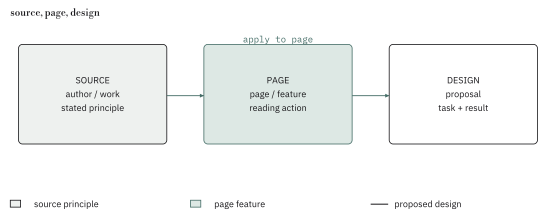
From a source record to a design proposal
Begin with the work and the action it asks of a reader. A designer's essay may explain how related facts should be grouped, while a module page may place an encounter number in a steady lane beside paragraphs of unequal length. The record supplies the designer's account, and the page supplies a visible arrangement. Comparing them brings the reading task into focus: finding one item quickly while retaining its connection to the surrounding information.
A proposed key layout can develop that comparison by holding numbers in one track and allowing descriptions to vary in length beside them. The designer can then check the route from a map location to its entry, watch for a number stranded at a page turn and move an immediate ruling closer to the action that needs it. The principle becomes concrete through these decisions about position and sequence.
The original examples in this atlas give those decisions a place to operate. A well, a service passage and a ferry shed provide locations with information to disclose and conditions that can change. Their schematics reduce each place to the relationships under discussion. A line shows a route, a label gives it an address, and a separate state record carries the change into a later visit.
The selected digital editions
The structural survey contains sixty blank masters, a twenty-page guide and a searchable inventory of 492 digital pages. It records page roles and normalized layout envelopes. Direct readings of the twelve modules add encounter instructions, rumors, allegiances and changes to locations, with digital-page references linking each reading to its source file.
The selected editions include S1's later typesetting, I1's fitted live text and U1's 2001 reconstruction. S3 contains sixty-four individually cropped illustration plates; N1's separated dungeon-map leaves are absent. X1 is the 1983 orange-cover revision. The count below follows these digital assemblies, including covers, inserts and cropped plates. Original physical leaf counts are a separate measure. The module source register gives the edition and file record for each copy.
| Module | Title | Digital pages |
|---|---|---|
| X1 | The Isle of Dread | 38 |
| B2 | The Keep on the Borderlands | 35 |
| B3 | Palace of the Silver Princess | 36 |
| N1 | Against the Cult of the Reptile God | 32 |
| S1 | Tomb of Horrors | 47 |
| S2 | White Plume Mountain | 20 |
| C1 | The Hidden Shrine of Tamoachan | 44 |
| I1 | Dwellers of the Forbidden City | 36 |
| T1 | The Village of Hommlet | 25 |
| U1 | The Sinister Secret of Saltmarsh | 38 |
| C2 | The Ghost Tower of Inverness | 36 |
| S3 | Expedition to the Barrier Peaks | 105 |
Total: 492 digital pages in twelve selected files, counting covers, inserts and individually cropped plates.