An original worked example
The Morrow Pump
Atlas pages 53–58
In this chapter
A place built to test the argument
The Morrow Pump is an original adventure setting built around a ferry crossing. A public notice, a keyed shed, a clue network and a return record connect what the party can see with the decisions available to its referee.
The Morrow Pump
The Morrow Pump is an original scenario built around a settlement's water supply. The pump stands beneath an abandoned ferry shed. Each evening, a keeper closes the crossing to keep drifting seed pods from jamming the intake. A recent repair has changed the sound of the mechanism, and travelers now mistake its amplified knocks for someone trapped below. The party can investigate the sound, question the keeper, inspect the intake or take a longer route to the far bank.
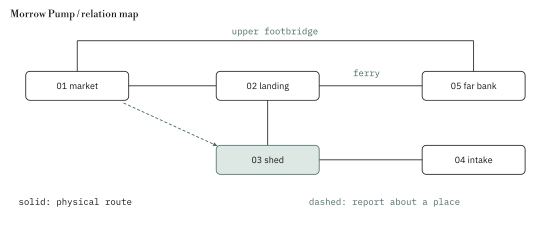
Five locations connect the sound, the machine and the crossing. Their addresses are reused in the map, key and information network. The party can approach through a conversation, an observation or an attempt to cross the water, with each route leading to another part of the situation. The closing bell changes the crossing while those investigations continue.
Solid connections show where a traveler can go. Dotted connections show reports about another place. A person at the market can describe the shed while remaining at the market. The keeper's presence is recorded in the key, where a later movement can be entered alongside the condition of the ferry.
The route back is also specified. After the evening bell, the ferry crossing closes. The party can still return by the upper footbridge, or persuade the keeper to reopen the crossing after clearing the intake. This change gives an earlier clue another use and makes the return depend on what the group learned or changed during its first passage.
What can cross the table
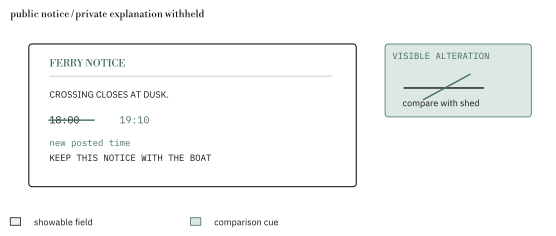
The public notice gives the travelers a closing time, a visible alteration and a reason to compare the words with the working ferry. The enlarged detail makes the alteration available for inspection. Players can question who changed the notice, look for the keeper or return at the stated hour to see what happens.
The referee's separate record explains that the crossed-out closing time follows the repair. The notice is one route to that history. A player who passes it can hear the revised schedule from the keeper or observe the ferry's closure. These overlapping sources bring the same practical question into view at different points along the route.
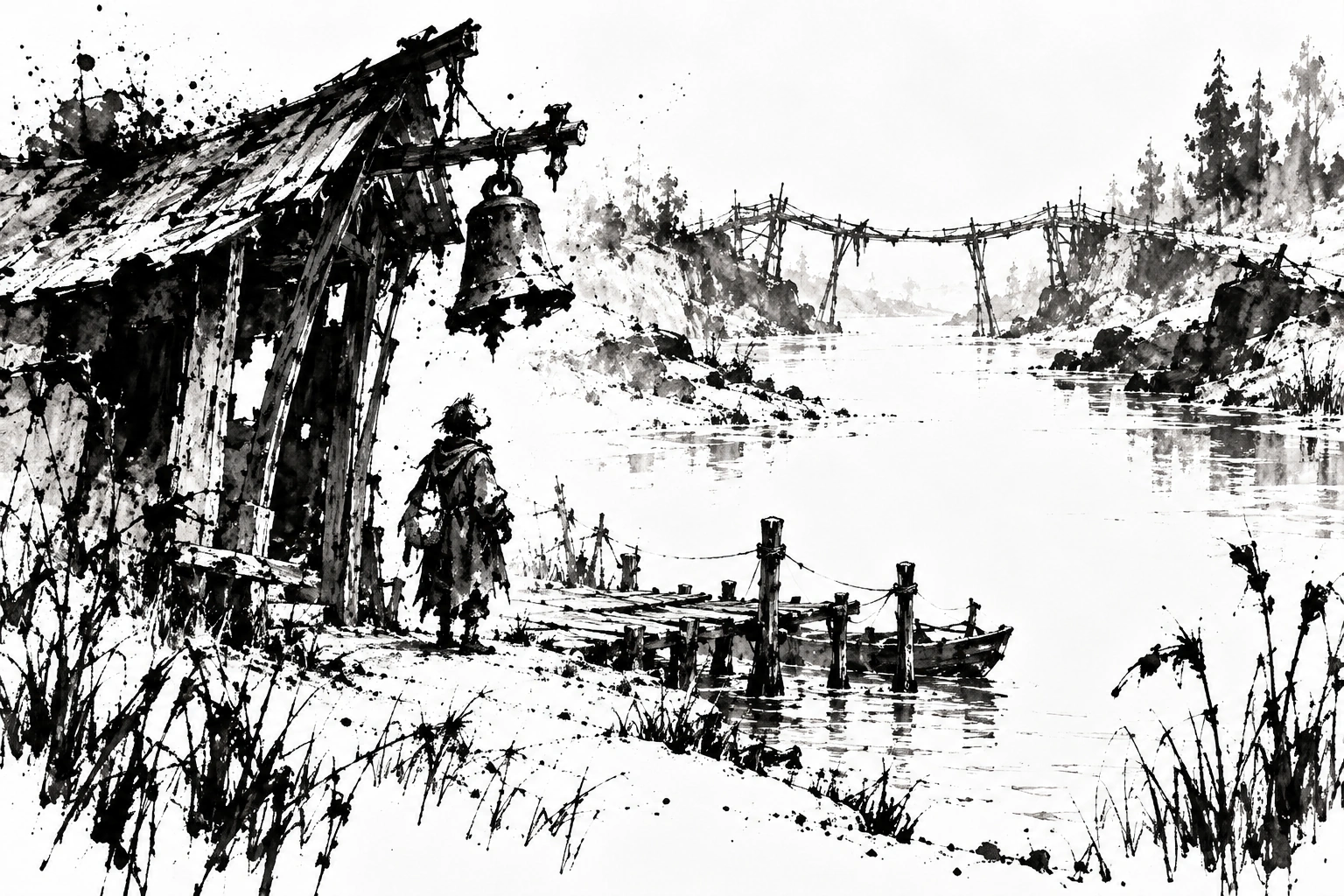
The border encloses the material that can be shown to the players. Ordinary type keeps the notice legible, and the altered time remains clear beside the replacement. The scene on page 53 gives the notice its setting by showing the shed, the bell and the distant footbridge that travelers can use after the crossing closes.
Present the notice as a separate sheet or show only its bordered field. The neighboring key holds the machine's cause and the keeper's knowledge, which become available through inspection and conversation. Keeping that page with the referee allows the players to study the alteration while deciding where to investigate.
The private record stays close to its trigger
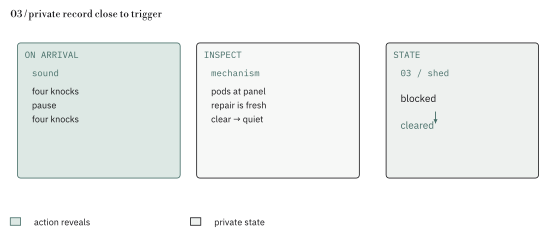
At location 03, a visitor hears four dull knocks followed by a pause. The key distinguishes the sound available on arrival from the mechanism found by inspection. The party can use either piece of information, but they become available through different actions. Keeping both in one undifferentiated paragraph would ask the referee to reconstruct that boundary while people wait.
The private record also names a change the party can cause. Removing the pods quiets the knocks and makes the ferry safe to reopen after the bell. A person who hears the sound again on returning should receive an updated description. The entry therefore includes a small state line, tied to an actual consequence, so that the second visit does not accidentally repeat a condition already changed.
The compact record names the location, the sound, its cause and the result of clearing the intake. A designer adapting the scenario to a game system can attach the relevant action procedure at that point. The rule then sits beside the event it resolves and the condition it changes.
Public text occupies a bounded field, private instructions begin with their triggers, and the state line sits beside the consequence it records. Labels could carry the same sequence in unboxed text. In either arrangement, the referee moves from the arrival description to the action that reveals the mechanism, then records the change for the next visit.
Three reports, one testable place
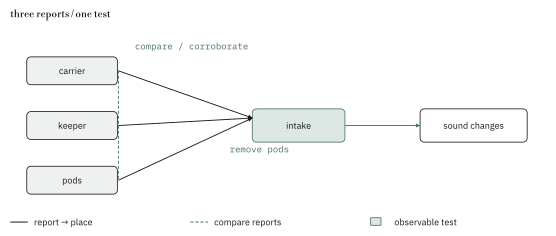
At the market, a carrier says that someone is knocking under the shed. At the ferry, the keeper says the new repair has made the machine louder. At the intake, fresh pods have collected against a vibrating panel. Each source has access to a different part of the situation, so the record keeps the speaker or object beside the information it supplies.
The carrier has heard the sound and supplied an explanation. The keeper knows the repair history but has not inspected the intake since noon. The visible pods give the party a material test. Removing them changes the sound and gives the party a result it can compare with both accounts.
Each solid link points toward a place where the party can act. The dotted link joins reports that can be compared once both have been found. A traveler who has heard the carrier can ask the keeper about the same sound; the keeper's account then gives the party a reason to inspect the recently repaired mechanism.
The party can reach the intake after hearing either account, and the visible pods give the investigation a physical test. The network therefore has several entrances and one shared point of action. Clearing the intake settles the immediate problem through a change that the players can hear and the referee can record.
The second visit earns its own entry
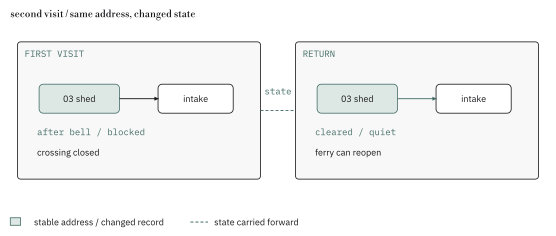
The party returns to the ferry shed after the evening bell. If the intake remains blocked, the crossing stays closed and the knocks continue. If the party cleared it, the keeper can reopen the ferry and the shed sounds different. The return entry carries the earlier intervention forward into both the available route and the arrival description.
The same map can serve both visits because the route geometry stays in place while the state record changes the conditions under which the party can use the crossing after the evening bell. The designer can record an inhabitant's movement or a door's status beside its existing address, keeping the return easy to check against the earlier decision.
The frame below places the first and second visits beside each other, using the same site drawing with a changed caption and route condition. In a longer adventure, those visits might be separated by many pages or sessions. A stable location address keeps the earlier entry easy to find when the referee checks which conditions still apply.
Trace the route from the public notice to the private key, then to the return record. The altered closing time points toward the keeper and the ferry; inspection reveals the blocked intake; clearing it permits the crossing to reopen. Place each of those connections on the surface the referee or players consult at that moment.