Page structures
Page structures
Atlas pages 7–12
In this chapter
A chassis that can change locally
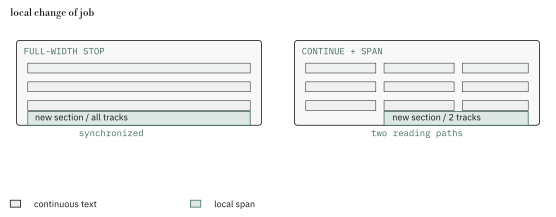
A stable column system lets the referee learn where the next line will be while leaving room for changes in reading width. The archive identifies a two-column baseline in T1, B3, C1, C2 and much of S2 and S3, while the 1983 X1 revision develops a three-column baseline. Each admits tables, drawings and larger spans when the material needs them. The tracks provide a framework within which a region can take on a different job.
Continuous prose needs a dependable reading path; a broad table needs neighboring values to remain comparable; an image needs enough uninterrupted area for the feature being inspected. When one of these units occupies two tracks, the remaining track can continue independently. X1 d29 provides a clear local transition, with an earlier section finishing in one column while a new heading occupies the other two.
The two proposed arrangements below handle a section change differently. In the first, text stops across the whole width. In the second, the right-hand tracks change role while the left continues. The second arrangement can save a page turn, but it also asks the reader to recognize two simultaneous reading paths. A stronger heading and a clear gutter mark where each path continues.
This atlas uses continuous columns for long arguments and broad bands for diagrams whose connections need space, while case studies keep the source reference near the passage it supports. Repeating those arrangements gives the reader a familiar place to look when moving from a module study to a comparison or a worked example.
The number is an address
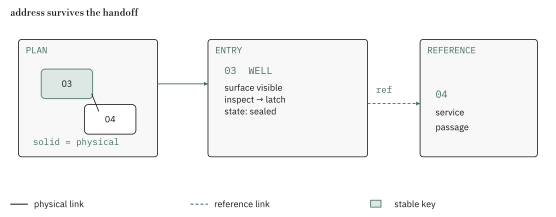
A keyed encounter connects two representations of a place. The map tells the referee where the characters are; the numbered entry supplies conditions, occupants and consequences. The key number is therefore an address that must remain stable while the surrounding prose changes length. Its graphic prominence should serve retrieval. An extravagant numeral that hides the opening line has spent the attention it was meant to save.
The archive's deep hanging-label pattern gives the address its own margin. The apparent white strip beside the text belongs to an entry's indent, and the body runs beneath its own heading. Expanding that indent into a permanent column would turn a compact sequence into a row of larger panels. The number needs enough separation to catch the eye while the description keeps a continuous reading path.
A map key also exposes a distinction between reading order and action order. An editor must print entries in some sequence, but players may reach entry seven before entry three. Each entry needs enough local context to support that arrival. Information required for an immediate ruling should be present or explicitly cross-referenced; information needed only for preparation can live elsewhere, provided the route to it is clear.
In the proposed well and service-passage key, the same address appears in the plan, entry and cross-reference. Trace the route with a finger, then follow it back from the passage to the plan. A missing number or inconsistent label becomes visible before the referee has to resolve it during play.
One room, two audiences
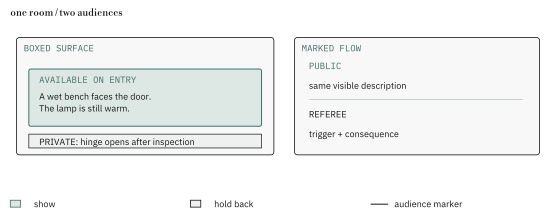
The referee and the players may consult the same imagined room through different surfaces. A read-aloud passage describes what a character can presently perceive; surrounding instructions can explain a concealed trigger, an occupant's intention or the effect of a failed action. The border or label marks the point at which the referee changes from presenting the room to administering what happens there.
C1, C2, N1 and U1 use selected bounded reading passages in the surveyed files. B2, T1, I1 and much of S1 and S3 depend more heavily on unboxed flow. Both approaches can separate audiences, but they place different demands on preparation and typographic discrimination. A box makes a physical boundary conspicuous. Unboxed flow depends more on headings, emphasis and the referee's understanding of the passage.
The invented room below carries the same visible description through two proposed arrangements. In the left arrangement, a plain rectangle identifies the words available at entry and a separate paragraph holds the mechanism. In the right, a compact label marks each audience. The rectangle gives the public passage a continuous visible boundary, while labels leave more room for uninterrupted text.
Cover the private material and read the public passage on its own. Then uncover the instructions and find the trigger that releases each hidden fact. The referee needs to distinguish information available on entry from information revealed by close inspection or a particular action, because those moments can occur several exchanges apart.
Mechanics need a different reading speed
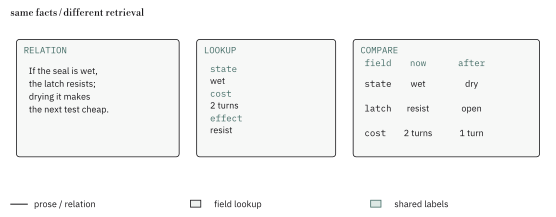
A paragraph invites the reader to carry a thought through time. A stat record asks for a value that may be needed out of sequence. An equipment roster asks the eye to compare people across shared fields. These are different reading operations, and the corpus gives them several shapes rather than a single card style.
Inline mechanics can keep a short ruling near the encounter that needs it. A vertical label/value list can make repeated attributes easier to locate. A shared label track can compare two related records without printing the field name twice. The fitted-text I1 edition places such a comparison at d27. B3 d34 combines a broad roster with narrow numerical fields and a wider equipment field before shifting to three equipment lists.
The invented records below hold the same facts in three proposed arrangements. Prose preserves a conditional relationship; a list supports retrieval by field; a matrix supports comparison across entities. The choice depends on whether the referee is following a consequence, finding one value or comparing several records during the same decision. Large separate cards would spread that comparison across a wider area.
Place a notes field where a referee will record a change, and keep a trigger close to the consequence it introduces. The distance between these elements affects what the reader must remember while scanning. Dense information can remain readable when related values share a position and the surrounding space separates one operation from the next.
A map changes scale and obligation
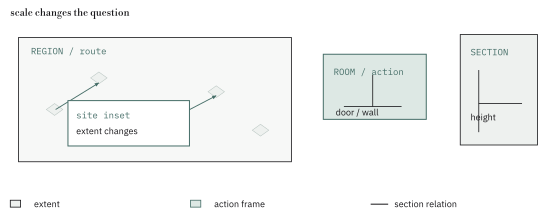
A regional hex field and a room plan both describe space, but they ask for different decisions. At the regional scale, a route can consume supplies and reveal a settlement or landmark. At the room scale, a wall, door or vertical separation may decide whether an action is possible. A section view answers a further question that a plan can hide: what lies above, below or across a change in height.
The structural survey separates square fields, hex fields, ungridded regional areas, insets and section strips. Its blank masters retain their relative positions and proportions. The scale model below develops that arrangement into nested views, with one frame for regional travel and another for a particular place, so the change in the reader's task remains visible.
A map inset needs an explicit relationship to its parent. A rectangle inside another rectangle can otherwise be mistaken for an adjoining room. The label, scale and boundary must tell the reader whether the inset enlarges a location, displays a different level or supplies a separate region. The selected files contain several such combinations, including B3's tall map with an upper-side inset, T1's plan and wall-section support, and S3's deck plans with a cross-section.
Physical handling matters as much as geometry. A foldout gives a large field room to remain legible while the booklet stays open to a key. Reducing it to a portrait page changes the size of labels and the distance between routes. A designer preparing a bound edition has to decide whether the map stays beside the encounter text, folds away from it or becomes a separate sheet that can remain on the table.
An illustration can hold the question open
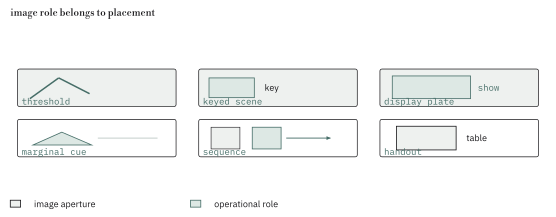
An image at a threshold prepares attention before the reader receives an explanation. An image beside a key can specify a visible feature. A player-facing plate lets several people inspect the same scene without receiving the referee's concealed information. A marginal cue can help someone return to a relevant passage. These roles may use similar drawing techniques, but they do different work.
The corpus makes these roles concrete. S1 and S3 have separate display sequences, C1 has paired visual fields, and C2 places visual aids and sideways character sheets within the digital booklet before the ordinary text pagination resumes. The reader changes from following prose to consulting or displaying an image, then returns to the keyed text.
The illustrations in this atlas occupy comparable positions. A bent threshold accompanies the discussion of entry; whispering figures sit beside a clue network; an invented malfunctioning device accompanies the problem of interpretation. Their pooled ink and broken contours give each situation a recognizable form. Routes and labels retain precise edges so the reader can follow the connection through the drawing.
Judge placement by the detail it brings into view. A threshold image can direct attention toward an entrance before the key describes what lies beyond it. A marginal figure can mark a passage that the reader will need again. If a picture conceals the detail discussed in its caption, change the crop, scale or position until the eye can move from the sentence to the relevant mark.