
Narrative operations
Narrative operations
Atlas pages 13–17
In this chapter
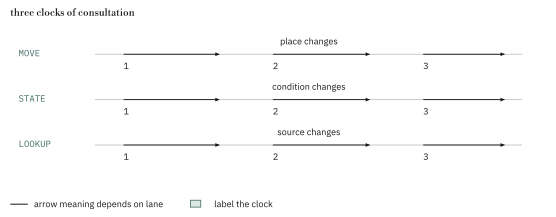
The page stores several kinds of time
An adventure may be printed as a sequence of numbered entries while the table produces a different sequence through movement. The referee reads ahead during preparation, scans sideways during a ruling and returns to an earlier record after a player changes the situation. Narrative time, reading time and lookup time therefore overlap without being identical.
Branching can occur in movement, response or procedure. A map offers several physical routes, an encounter permits several responses, and a referee's procedure can branch according to a die result. A route changes where the party goes; a response changes what happens there; a procedure changes how a rule is resolved. Distinct line styles and labels let a diagram carry these relations together.
The comparison across cases follows these differences. S2 organizes a set of retrieval objectives through spatial alternatives. C1 places pressure on exploration through a constrained situation and hazardous environment. S3 makes the interpretation and use of unfamiliar devices part of the activity. Their pages can all contain numbers and diagrams while supporting distinct kinds of uncertainty.
The proposed schematic below separates a physical path from a conditional action and a consultation step. The referee can retrace the physical path while carrying forward a spent resource or an alerted inhabitant. Distinct arrows keep the route, the changed condition and the return to a written record visible at the same time.
Return changes the value of a place
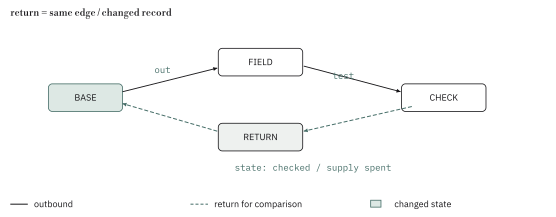
A return route gives earlier information another use. A landmark that helped the party enter can help them leave; a settlement that supplied a rumor can become a place to test it; a previously safe passage may acquire consequences after an alarm. Encounter instructions and a record of the changed condition connect the first visit to the next.
A hub-and-spoke arrangement connects a base to several expedition sites. The base can also hold concealed factions and dangerous relationships. T1 and N1 place social information within the settlement as well as along routes leading away from it. B2 connects a defended settlement to a nearby field of threats. Returning to the base can therefore bring new information into an existing relationship.
The proposed return network below uses the same edges for the outward and homeward routes. On the second pass, the party brings a changed record: a source has been checked, an entrance exposed or a supply spent. Placing that record beside the location address lets the referee find both the route and its current condition during the next consultation.
Give the return record a trigger and a visible result. If an alarm has alerted the inhabitants, record who moves and which approach they can now watch. If a conversation has settled a rumor, update the speaker's information beside the original entry. The next visit then begins with the consequence of the earlier action already available to the referee.
A rumor needs a source and a test
A rumor distributes information unevenly. Someone says something, the party decides how much to trust it, and later evidence may confirm, qualify or contradict it. A rumor table is therefore more than an opening list of hooks. It can create different initial pictures of the same place, especially when a claim is false, partial or tied to a particular speaker.
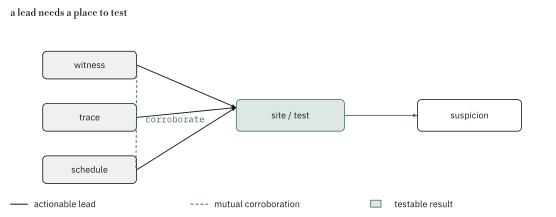
A clue network connects discoverable evidence to the places and actions it suggests. Record where each clue can be found, what reveals it and where it points. The reader can then follow an investigation through the information available to the party at each stage. A missed location becomes visible as a missing route through the network.
The proposed network below gives three routes to the same practical suspicion. A witness describes a sound, a physical trace suggests recent passage, and a schedule makes the activity possible. The pieces overlap without saying exactly the same thing. If one is missed, the others still give the party something to investigate; finding all three brings the reports into closer agreement.
Information asymmetry becomes playable when the players can act on the difference between what they know and what they suspect. A hidden cause needs an observable effect, a report or an object that invites examination. The referee's record names the action that reveals each piece. N1 and U1 provide examples of concealed social and material arrangements in the case studies that follow.
Escalation requires a condition
A threat can become more urgent because time passes, a boundary is crossed, a resource is consumed or an opponent learns something. These mechanisms differ from a sequence of increasingly dangerous rooms. Both can create pressure, but only the first group requires the referee to track a changing state beyond the current room.
Time limits, environmental hazards and alarms require different records. A time limit needs an elapsed interval and an endpoint. A hazard needs the condition that exposes a character to it. An alarm needs the event that alerts someone and the response that follows. These details tell the referee when to consult the rule and which parts of the situation to update.
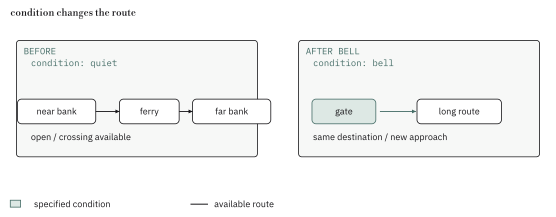
The proposed ferry example below ties a route change to a bell. Before the bell, the crossing is available; after it, the same destination requires another approach. The record places the event beside its consequence so that the referee can update the route as soon as the bell sounds, including when the party is occupied elsewhere.
After the crossing closes, the party can investigate the closure, seek another route or try to persuade the keeper to reopen it. Each response begins from the same recorded change. An escalation entry therefore needs to remain available alongside the map and the local key, where the referee can consult it while resolving a new plan.
The exceptions carry information
Two-column prose recurs across the surveyed files, alongside three-column pages, empty stocking fields and separate picture packets. These departures correspond to different tasks. A referee fills an encounter field during preparation, follows columns while reading and turns a display toward the players during play. Each task gives the page a different arrangement and handling sequence.
B3's orange-cover version contains open stocking space for the referee to complete. Its blank intervals and open-ended boxes leave room for encounter preparation, and the instructions give those spaces their role. The field has a shape before it has contents: a number establishes its address, surrounding entries establish the sequence, and the available area sets a practical scale for the addition.
X1's 1983 revision uses a three-column grid, running furniture, pictogram contents and an angled handout field. A section can finish in one track while another begins across the remaining two. The contents pictograms offer a different entry into the booklet, and the angled field interrupts the regular vertical reading path with an object that has its own orientation.
S3 combines technical diagrams with player displays. Its sixty-four cropped illustration plates form separate digital pages in the selected PDF. The reader moves between these views and the encounter text, using a shared visual detail while consulting information held on another surface. The digital assembly and its page count are recorded in the module source register.
The N1 file contains encounter prose and settlement material, with the separated dungeon-map leaves absent from the selected assembly. The keyed entries still supply local conditions and actions for study. Here the unit of comparison is the encounter record and its information, while the source register records the missing map component.
A repeated arrangement gives the referee a place to look; a local departure gives a particular task room to occur. Columns carry an argument, a wide table aligns values and a display separates a visible scene from its explanation. A new adventure can retain those relationships while changing the size and sequence of the surfaces that carry them.