Historical design comparisons
The image before the instruction
Atlas pages 46
In this chapter
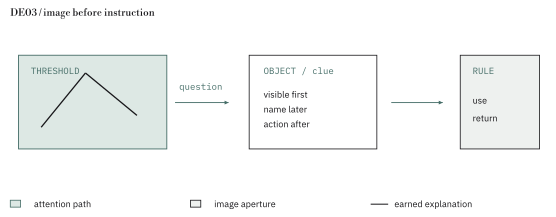
Before a reader studies a key or a contents list, a large image has already introduced the book. A cover filled with combat directs attention toward opponents and conflict. A sealed threshold raises a question of entry, while a strange apparatus invites inspection of its parts. The opening spread can continue that attention by placing the corresponding question beside the information needed to pursue it. Choosing a threshold picture therefore includes choosing what the reader should look for on the pages immediately after it.
Denver Art Museum describes Saul Bass’s poster for The Man with the Golden Arm as a reduction to one dominant symbol, the jagged arm. MoMA’s separate object record dates its poster to 1955 and identifies it as a lithograph. In the Denver account, the arm concentrates the film’s subject into a recurring image for its presentation. That concentration places one recognizable form ahead of a fuller explanation, giving the viewer a subject to carry from the poster into the film. [D03; D04, object 202.1956]
The module study distinguishes cover hierarchy, interior title page and player display plate. Each can carry a large image, with a different audience and place in the reading sequence. A cover introduces the publication. An interior title picture marks the transition into the body. A display plate gives players a scene to inspect during play. The T35, T36 and T27 masters record the image field and surrounding page structure for these three uses, including the room available for a title, a caption or adjacent text. [L, pp. 13–14]
For a new threshold illustration, imagine a travelling bell whose torn mouth opens onto a narrow stair. The bell gives the viewer a recognizable whole; the stair introduces a question of access. Pooled ink can thicken the bell’s lower edge, with broken contours around its mouth and a clear paper gap along the stair. Place this image at the opening of an account of entry and concealed routes, where the reader can follow the depicted passage before encountering a key. Give the figure a caption that identifies the bell and stair as the example under discussion.
A player handout needs a different release condition. If the stair represents a concealed route, showing the complete illustration reveals it. For a proposed pair of facing views, give the referee the whole bell and its interior stair, and give the players its closed exterior. Add the condition for showing the second view to the encounter key. When the party opens the bell, the referee can turn to the interior image and put it on the table, allowing the newly visible passage to become part of the players’ next decision.