Historical design comparisons
A turn of the page changes the scene
Atlas pages 47
In this chapter
A spread gives the reader several things at once, while a page turn removes some of them before the next arrangement appears. This difference matters when a book alternates a map, an encounter description and an image that can be shown to other people. A reader moving through the pages in order sees that sequence unfold. At a game table, the referee may keep the map open and return to the same description several times, using room numbers and page references to reach the needed passage from either direction.
The Barnes Foundation’s account of Alexey Brodovitch’s work at Harper’s Bazaar describes groups of small photographs, white space and shifts in scale, layering and colour across a sequence of spreads. It also records his photographs of visiting Ballets Russes de Monte Carlo performances in 1935–37 and their publication in Ballet in 1945. The Jewish Museum’s exhibition checklist identifies individual examples, including Choreartium (Three Men Jumping) and Cotillion (Ballerinas Leaving the Stage), both associated with that book. The named images and the Barnes account connect editorial pacing to the placement and changing scale of photographed movement. [D05; D06, digital pp. 9–10]
S3 digital pages 24–25 place tall image regions toward the central fold and prose toward the outside. The structural study’s T44 master records the pair as two facing inner visual columns. Each picture occupies an edge of the central opening, while the outer columns carry the text. A reader can inspect the two images together and move outward to the adjacent descriptions. This arrangement establishes a relation across the spread as well as a relation between each picture and the text on its own page. [L, pp. 7, 16; S3 digital pp. 24–25]
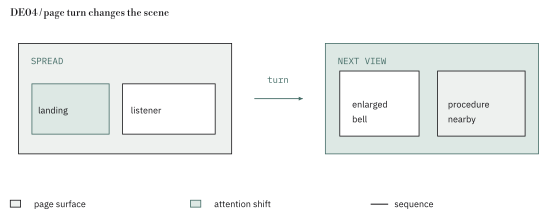
For a proposed encounter sequence, begin with a distant ferry landing and a small figure listening from the bank. On the next spread, enlarge the damaged bell above the stair and leave the figure out. Follow the scene with an operational diagram that locates the bell, stair and landing together. The change in scale moves from the approach to a particular object, then returns that object to the route through the place. Keep the image captions beside their scenes so that the bell retains its name as its size and surroundings change.
During repeated consultation, the referee also needs a route directly to the rule. Give the proposed scene a stable identifier that survives every change of scale, and connect it to an index or small overview diagram. The reader turning forward can follow the illustrated sequence; the returning referee can use the identifier to reach the damaged bell’s entry while keeping the map open. Check the cross-references by entering at each surface in turn, including the isolated image, and following its label back to the encounter description.