Historical design comparisons
Illustration with a job to do
Atlas pages 48
In this chapter
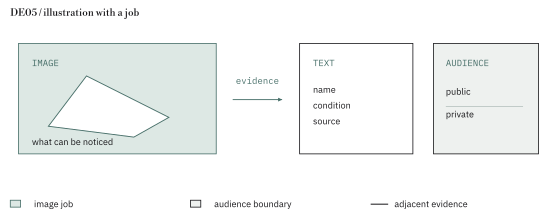
An illustration can describe the people who use a place, identify an object the reader will need again or establish an uncertainty that the text has yet to resolve. It can also occupy the space needed for an explanation. The commission therefore begins with the particular object, condition or choice that the reader must be able to see. A picture of a doorway might show the worn edge of a latch, the height of a barred opening or the place where a rope disappears through the wall. Each assignment calls for a different view.
RIT’s Cary Graphic Arts Collection records that Cipe Pineles became art director of Seventeen in 1947 and commissioned painters to illustrate fiction. It also records her subsequent work with editor Helen Valentine at Charm, addressing women who worked. The Jewish Museum’s 2021 exhibition checklist identifies “We Work Too,” in the August 1950 Charm, with photography by Robert Frank and art direction by Pineles. Together, these records describe Pineles’s work through the artists she commissioned, the editorial subjects they addressed and the images arranged on the magazine page. [D07; D06, digital p. 22]
The checklist thumbnail for “We Work Too” shows a large photographic field beside a narrower text field. Image and prose occupy adjacent territories, allowing the photograph to establish a scene alongside the article’s account. The module study records several other placements, including a broad image band, a column inset and an angled embedded handout. X1 digital page 6 interrupts the surrounding columns with an angled document field; S2 digital page 17 sets a stanza handout apart and gives it a closing mark. Those boundaries distinguish the document players receive from the instructions surrounding it. [D06, digital p. 22; L01, pp. 17–18]
In a new encounter layout, a marginal creature can mark a warning beside the relevant entry, provided the warning stays legible and the same cue recurs at other entries with that function. A keyed scene can show several physical details while the referee’s causal account occupies a separate field. Give a handout a torn or stained edge with a clean area inside it for words and symbols. Let splatter build the depicted object through pooled shadows, broken contours and gaps in the paper, while labels sit on a stable alignment outside the drawing.
For a proposed spread, draw the same invented ferry token in two roles. Place a small spot image beside the key so the referee can identify it, then give the players a larger view showing the features that fit the gate mechanism. Keep those features consistent across both drawings, including the notch that meets the gate and the mark that distinguishes the token from an ordinary coin. The caption can direct attention to those details; the key records what happens when the token enters the slot.