Historical design comparisons
Rules that leave work for a player
Atlas pages 45
In this chapter
An empty field gives the designer work to do when the surrounding instructions establish what belongs there. The blank structural masters preserve several such relationships. A map field establishes the area in which routes can be drawn, and a key lane connects locations to their descriptions. A reading box separates a passage intended for the table from material that belongs to the referee. These fixed relations let the person completing the page choose its contents while keeping the room address, description and audience visible to the people who will use them.
Paul Rand’s “Design and the Play Instinct,” published in Education of Vision in 1965, discusses how a stated design problem can engage attention. Rand joins constraints to experimentation through assignments whose defined limits give the student something to work against. His examples include the tangram and exercises in proportion, and the discussion moves between abstract arrangements and their practical applications. The student makes choices within a known problem, rearranges the available material and can compare the result with the conditions of the assignment. [D02, opening argument and tangram discussion]
The layout study identifies deliberate stocking spaces in the orange B3, including digital pages 11, 14–20, 22–23 and 26. It also records a blank graph worksheet in B2. These published spaces invite later completion. Other blank masters were made by removing content from an occupied module page, retaining the positions of its map, key or reading fields. The first gives the referee an assignment inside the adventure; the second gives a new designer a page structure to fill. The source inventory records which kind of blank each master represents. [L, pp. 5–6, 10, 12]
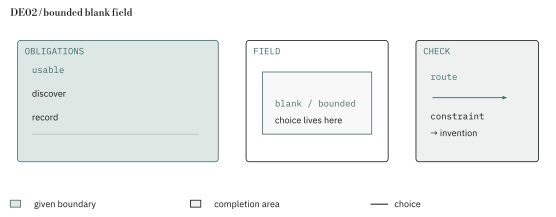
For a new design exercise, place a rain collector above an abandoned ferry stair. Give the designer three obligations. The party must have a way to learn that the stair is usable, discover a cost attached to using it and choose another route. Leave the inhabitants, the method of discovery and the cost undecided. One designer might connect the collector to a toll mechanism, while another might make the water itself evidence of recent use. The fixed obligations let both encounters provide decisions through different objects and actions.
Each completed field needs a consequence in play. An illustration reserve can identify the stair, show its condition or expose a choice of approach. A rumor field needs a speaker and a route or action that the report makes possible, with false information identified in the referee’s key. The page then carries enough information to put the exercise into conversation. A player may distrust the speaker, inspect the collector or leave by another route; the referee needs to find the relevant description and consequence as each decision changes the party’s approach.