Module case studies · S1
Tomb of Horrors
Atlas pages 33–34
In this chapter
A route that makes the party doubt its own progress
The party reaches a hill and must decide where and how to search its face before reaching a keyed entrance. S1 gives the referee specific search durations, tools and digging arrangements, while leaving the choice of position to the players. Its introduction also warns that traps and problems outweigh monster fights. Finding the route requires the group to choose a place, commit time and inspect the result. Even after an entrance appears, testing its surfaces and passages continues to occupy much of the expedition. [S1, digital p. 3; search procedure and referee notes.]
At the entrances, description and mechanism occupy adjacent prose. One tunnel conceals unstable stone above the party; another starts a closing-block countdown. The main corridor includes painted surfaces, a coloured path and an embedded message that becomes legible only after sustained observation. Some details can be reported immediately, some require an announced action, and others enter play when the referee resolves a mechanism. Numbered illustrations are called for at specific moments. The key therefore controls both what the party can inspect and the action or duration required to receive the next description. [S1, digital p. 4; keys 1–4.]
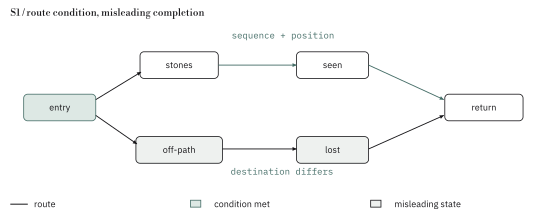
The arches make the route depend on both an action and a position. In key 5, pressing coloured stones changes what can be seen; passing through on or off the path produces different destinations. Key 7 returns survivors through a constrained route, while the arch in key 10 separates living travellers from their possessions. A route graph needs those conditions on its connecting arrows. Sequence, position, carried objects and direction determine which destination follows from a crossing, so two characters approaching the same arch can leave it in different places and conditions. [S1, digital p. 5; keys 5, 7 and 10.]
Tomb of Horrors
Later, the false crypt stages a complete-looking finish. The apparent enemy, a conspicuously effective weapon and a simulated collapse encourage a hurried departure. The text supplies reasons for suspicion, including the condition of a bag, and discusses how further investigation can expose the deception. Severe penalties and misleading cues make the decision consequential. The scene asks the players to decide whether the apparent resolution is enough to justify leaving, and the referee holds a separate account of what remains behind that apparent ending. [S1, digital p. 7; key 18.]
Return is unusually complicated here. The introduction permits several sessions and recovery between them, removes ordinary wandering-monster encounters, and advises the referee to withhold the relative safety of the entrance. Its separate note imposes a per-round demon check on astral or ethereal characters. Other returns force displacement or confiscate equipment. In a route diagram, each return arrow needs its own result: recovery, relocation, loss of possessions or a departure prompted by apparent completion. The pressure comes from these conditions and the keyed hazards, with the astral or ethereal check applying to its specified travellers. [S1, digital pp. 3, 5, 7.]