Module case studies · B2
The Keep on the Borderlands
Atlas pages 19–20
In this chapter
A base that changes between visits
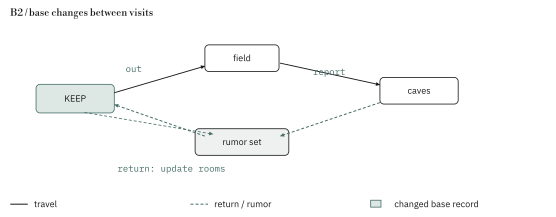
The party enters a guarded settlement before it enters the caves. That first exchange matters because the Keep supplies lodging, provisions, help and social consequences, while excursions into the ravine consume resources that bring the party back. The introductory instructions explicitly describe a continuing home base, and the session procedure asks the referee to change explored areas after the adventurers leave [B2 d4, d7–8]. A return-loop diagram connects the two places and records what travels between them. Wounded characters, recovered treasure and news from the caves change the circumstances of the next visit.
Rumor makes the route to the caves uneven before anyone draws a map. The referee may give each player a private report, and players may choose whether to share it; the table identifies false reports for the referee without making that distinction available to the adventurers [B2 d7, d9]. On digital page 9 the list sits beneath instructions for releasing it. A referee consulting the list can see both the report and the rule governing who receives it. A proposed rumor diagram uses one line for transmission and a separate mark for reliability, so a report can pass between several people while its accuracy remains a private referee entry.
The caves’ overview describes tribal conflict, adaptation to adventurer tactics, consequences of ransom and later occupation of cleared areas [B2 d16]. These instructions change the situation attached to each numbered location. A key identifies where a group begins, while the surrounding procedures govern movement and response. A proposed state panel beside a stable room number records the new defender, warning device or affiliation after an excursion. The referee can update the occupation and defenses while continuing to use the same address on the map.
The Keep on the Borderlands
The mapping instructions introduce a further division between kinds of knowledge. Players construct their own map from spoken directions, and the referee is cautioned against correcting every mistake [B2 d7–8]. The printed map supplies the referee’s geography; the player map records what the group has understood from the description. In a staged mapping example, the reader first receives a spoken route, then draws it, then compares that drawing with the complete plan. A missed turning or mistaken distance can be traced to the description that produced it, and the next passage changes what the players can locate.
The Keep also changes who will receive the party and what support becomes available. The inner-bailey instructions relate access to conduct and service, giving the return journey a social consequence [B2 d9]. A boundary around the base can therefore carry conditions for admission, while annotations on the return arrows record what the party has done and whom it can now approach. Retreat, unsuccessful bargaining and renewed preparation each lead back through that boundary. Across the ravine, the caves’ occupants are also adjusting to the party’s last visit.