Module case studies · N1
Against the Cult of the Reptile God
Atlas pages 23–24
In this chapter
A village read through suspicion
Orlane asks the adventurers to judge people whose visible behavior is unreliable. The introductory village instructions explain that cult members and other citizens cannot generally be distinguished by appearance; apparent friendliness may conceal danger, while honest residents may be frightened and withdrawn [N1 d6]. A player-facing description gives the party a resident’s behavior. The referee’s account adds allegiance, motive and the conditions under which that behavior may change. An allegiance diagram consequently belongs beside the private key, where the referee can consult it while the players work from what they have seen and heard.
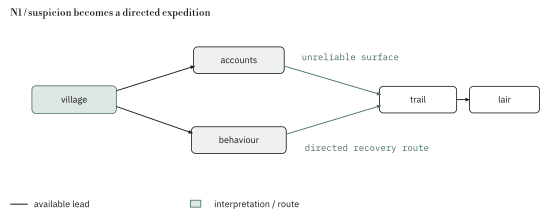
The module sets out three stages: investigation in the village, travel toward the cult headquarters and exploration of the lair [N1 d5]. Within the first stage, knowledge arrives through several residents. The weaver and liveryman provide warnings and observations, while the mayor combines suspicions with a mistaken theory about the hermit [N1 d8–9]. A relationship diagram connects each speaker to a report and the place it concerns. Marking a report as observation, inference or suspicion lets the referee follow how several accounts can agree about a disturbance while disagreeing about its cause.
The key’s first layer gives the referee an arrival description. Its surrounding text contains motives, affiliations and conditions that become relevant through questions or actions [N1 d5–6]. The division also follows time: the party sees a building before it earns another person’s confidence. A proposed encounter layout places the arrival description above a private note with the resident’s motive and the action that could change their response. As conversation develops, the referee moves from the shared description to the relevant condition and reveals the next piece of information.
Against the Cult of the Reptile God
The settlement continues to change when the party rests or leaves. Digital page 22 supplies abduction procedures and a schedule for attempted kidnappings of villagers; the earlier introduction explicitly warns that cult activity continues during journeys away for training [N1 d6, d22]. A return diagram can keep the village’s geography constant and attach the scheduled attempts to elapsed time. When an attempt occurs, the referee updates the affected resident’s status. The next visit then begins with the consequences recorded against that house and the people connected to it.
Ramne and his familiar provide a strong route to the lair, while the introduction allows alternative leads and the trail instructions help the referee bring the party to the destination [N1 d6, d13–14, d23]. The village investigation can stall, and these provisions give the referee ways to resume the expedition. The structure narrows from uncertain social encounters to a directed journey and the exploration of a particular headquarters. The conclusion then returns attention to Orlane’s recovery and future dangers [N1 d31]. The party’s discoveries and actions at the lair acquire consequences in the houses and relationships encountered at the beginning.