Module case studies · B3
Palace of the Silver Princess
Atlas pages 27–28
In this chapter
An unfinished room can change on return
An empty room is a deliberate part of this version’s working method. The introduction tells the referee to leave some areas unstocked and revisit them later, so a room that once offered rest may change before the party returns. Blocked passages also provide places to extend the complex. The orange-cover B3 therefore puts some of its future in the referee’s hands while retaining enough completed encounters to demonstrate how the unfinished areas might be used. [B3, digital p. 4]
Its information also travels outside the palace. The tinker’s rounds give the referee a plausible person through whom news can pass, and the rumor section allows false, true and partly true accounts. It even proposes a rumor sheet or campaign newsletter, extending circulation beyond the session. A report can consequently arrive before the characters reach the location that will test it, and the person who carries that report has an ordinary reason to travel. [B3, digital pp. 8–9]
The reading boundary is unusually explicit. The instructions identify the boxes as information to give players on entering an area and reserve unboxed material for the referee, including facts revealed only after a search. Elsewhere, blank fields sit beside finished descriptions. The page alternates between presentation, adjudication and authoring space, with the blank fields providing room for the referee to add inhabitants and conditions. [B3, digital pp. 10, 16]

Palace of the Silver Princess
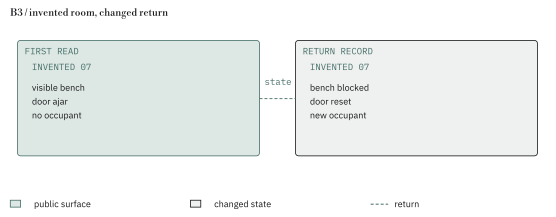
An original two-visit example applies B3’s restocking procedure to a storage chamber. On the first visit, the chamber contains a visible bench, a wet floor and no occupant. On the second, a displaced creature has moved in and blocked the bench with its bedding. The diagram keeps the same room address while the drawing changes the evidence a visitor can see, and a separate occupancy record holds the creature’s arrival and its effects on the room. The referee can update those conditions while retaining the chamber’s dimensions and connections.
A proposed rumor sheet gives each public report a named speaker and keeps its truth flag in a separate referee register. A date belongs on the sheet when the age of the report affects what the players can infer from it. Several reports may point toward the storage chamber: one describes a dry place to sleep, another mentions recent footsteps, and a third records a missing bundle of straw. The register connects each report to the visit or inspection that could test it, preserving the difference between the chamber’s earlier use and its current occupant.
The finished key and the empty field require different amounts of space. A finished key gathers the description, occupants and procedures the referee needs during a visit; a field awaiting a decision leaves room for additions. Place the two visits to the storage chamber together, with the second occupancy record beside the changed drawing. The reader can compare the new bedding and blocked bench with the first visit while following the room number back to the same position on the plan.