Module case studies · C2
The Ghost Tower of Inverness
Atlas pages 39–40
In this chapter
Four collection routes become a single ascent
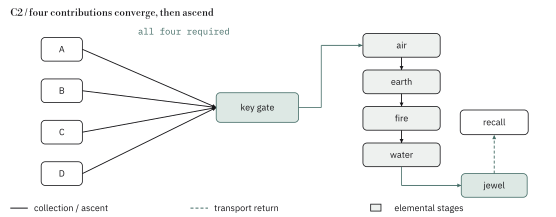
Inverness gives the referee a clear objective beneath the ruined keep: collect four parts of a key, with one part placed along each of four routes toward the central room. The text organizes those routes by entrance and states that all lead to the same locked destination. The party may choose its order, but the central door requires the completed collection. A convergence diagram therefore marks each contribution separately, with all four feeding the shared gate. The route order can change while the collection requirement remains fixed. [C2, digital pp. 9–10; dungeon-level instructions and keys.]
The central room changes both the setting and the arrangement of play. Once the assembled key opens it and the survivors enter, a short countdown precedes transport into the tower’s past. Above them lie levels associated with air, earth, fire and water, followed by the jewel chamber. The referee knows the time shift before the players do, and the module awards recognition of that change. The expedition through ruins becomes an ascent through an intact structure, with the collecting routes giving way to a sequence of levels above the transport chamber. [C2, digital pp. 26–27; keys 14–17 and tower introduction.]
The tournament rules explain why that ascent constrains escape. The tower prevents departure except through the supplied recall amulet, with the text explicitly connecting the restriction to comparable challenges for tournament teams. The same introductory material separates boxed descriptions from hidden referee information, marks non-tournament encounters differently and recommends a three-hour real-time limit. These provisions belong to one operating arrangement. The graphic hierarchy helps the referee distinguish what to say, what to omit for this mode and what to record while the players work through a fixed span of time. Campaign use can alter several of those constraints. [C2, digital pp. 5–7, 27.]
The Ghost Tower of Inverness
The chess encounter provides a compact example of action, feedback and recordkeeping. The characters arrive in assigned positions, movement produces visible changes and damage depends on whether each character follows an underlying rule. A displayed visual aid establishes the shared board, while the referee keeps track of starting positions and later permissions. The source accepts ways of bypassing the floor and explains how those choices affect subsequent movement. The nearby diagram locates the positions, the box reports what the party perceives and the unboxed instructions tell the referee how each move changes the encounter. [C2, digital pp. 13, 15, 26; keys 12–13 and visual aid 2.]
At the final gem, player positions become essential information. The source tells the referee to use a visual aid divided into sectors and to track repeated rays, with a predetermined sequence for tournament use. Returning the objective and bringing companions back both affect the score. The recall amulet ends the expedition through a specified transport procedure. The scoring sheets then combine decisions, damage and elapsed turns into a written record of the session, allowing the referee to evaluate what happened during the collection, ascent and return. [C2, digital p. 31, key 33; digital pp. 34–35, record and scoring sheets.]