Module case studies · C1
The Hidden Shrine of Tamoachan
Atlas pages 37–38
In this chapter
An escape route measured against two clocks
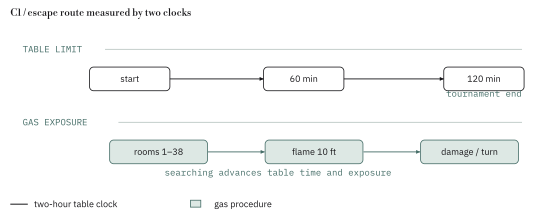
Tamoachan begins its tournament expedition by dropping the party below ground. The immediate objective is escape, and the lower chambers contain poisonous air. The campaign instructions also allow a more conventional entrance and later returns. In the tournament opening, the party starts inside the danger and must find a way upward while the air continues to damage them, making a prolonged search increasingly costly even where several routes are available. C1 gives the group an environmental reason to move before any particular monster becomes the focus of play. [C1, digital pp. 3–5; background, referee notes and key 1.]
The instructions specify a two-hour limit for tournament play and offer a shorter version ending at room 39. Poison damage supplies a second pressure within the fiction, with the affected area defined as rooms and passages 1 through 38. The gas also reduces the range of flame-based light. Searching therefore costs both table time and exposure, while limited visibility constrains what can be described at once. C1 gives the referee guidance about reporting remaining minutes. A two-clock record can place that announced time beside the exposure procedure, with each entry tied to the action or interval that advances it. [C1, digital p. 4; gas and tournament rules.]
The page explicitly establishes two audiences. Boxed passages supply information to read aloud, and the unboxed passages supply referee knowledge. The introduction warns that two encounter descriptions depend on the direction of approach; it also directs the referee to show keyed illustrations according to what the characters can see. The border locates the shared description, and the key and illustration number direct the referee to the next passage or image. The direction-sensitive encounters add a further step: establish the party’s approach, then select the description that belongs to it. [C1, digital p. 3; Notes for the Dungeon Master.]
The Hidden Shrine of Tamoachan
The opening vault demonstrates how disclosure depends on available light. Before illumination, the referee describes what the characters touch, and the source distinguishes normal magical light from the weak range of a flame in the poisoned air. Elsewhere, a sand trap gives its changing effects in a round-by-round table, specifying when movement becomes restricted and when escape becomes much harder. The encounter intensifies as the referee advances through those rows. A proposed encounter panel pairs the state sequence with its timing instruction, placing the current restriction beside the next change the referee must apply. [C1, digital p. 5, key 1; digital p. 14, continuation of key 24.]
Campaign return changes the problem again. The introductory notes permit withdrawal to replenish spells or obtain equipment and tell the referee to restock some cleared areas while maintaining balance. The gas can eventually disperse after doors are opened, but on a timescale much longer than a tournament sitting. The referee can therefore run an urgent competitive escape or allow a campaign expedition to return with different equipment and encounter changed conditions. C1 describes its fictional temple as drawing on Maya and Aztec/Toltec material, combining those references within the invented setting of the adventure. [C1, digital pp. 3–4; module background, return and ventilation instructions.]