Module case studies · S3
Expedition to the Barrier Peaks
Atlas pages 41–42
In this chapter
Showing the object starts another procedure
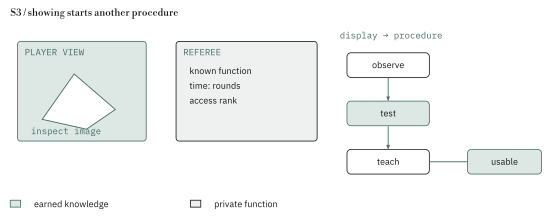
A picture in S3 enters play under explicit instructions. The referee must show illustrations at the appropriate moment and may allow players to study them as long as they wish, while recording the passing minutes as rounds. Looking therefore consumes adventure time. Players can keep examining a plate, compare its details and discuss what an object might do while the referee advances the clock and continues the procedures attached to it. [S3, digital p. 10]
The concealed nature of the site sharpens that role. Referee explanations identify a technological environment, while descriptions for the characters use familiar materials and comparisons to describe unfamiliar devices. The atmosphere analyzer, for example, receives both an account of its visible surfaces and an explanation of what its indicators measure. The players inspect the surfaces and indicators; the referee knows their functions. Showing the image lets the group point to particular features, form an explanation and choose what to test. [S3, digital pp. 11, 34]
Access is another form of hidden information. The colored cards belong to a ranked system, with an explicit exception and consequences for using an unsuitable card. The module tells the referee not to explain their function in advance. Elsewhere, the entrance’s opening cycle and the waiting support party give time concrete consequences; the garden level also changes between light and darkness on its own schedule. Doors, illumination and the party’s opportunity to leave therefore require the referee to track more than position on a map. [S3, digital p. 11]
Expedition to the Barrier Peaks
Learning an item then receives a separate diagrammatic procedure. Four charts distinguish simple from complex devices and lethal from nonlethal ones. A character’s attempts take time, rolls determine progress or setbacks, and previous observation or instruction can modify the attempt. Once someone understands an item, the text specifies how that knowledge can be taught to another character, carrying the result of one person’s experiments into the procedures available to the rest of the group. [S3, digital pp. 28–29]
A proposed instrument encounter places an unnamed device in a player-facing frame beside a private function note and a decision diagram. The drawing gives the instrument a few distinct working parts that the players can examine. The diagram links observation, testing and instruction to changes in what the group can do, and a second panel shows the information obtained after a successful test. Revealing that panel changes the next decision: the group can operate the part it now understands or continue investigating another part.
S3 coordinates a room key, a numbered display and the procedures for inspecting or operating what the display shows. The referee moves between those surfaces as the group enters a location, examines a device and attempts to use it. A proposed encounter spread places the display number beside the room address and keeps the time instruction with the testing sequence. The referee can locate the image during the arrival description, then continue from the same reference as the players begin experimenting. [S3, digital pp. 10–11; archived source register]