Historical design comparisons
Find the rule while everyone waits
Atlas pages 49
In this chapter
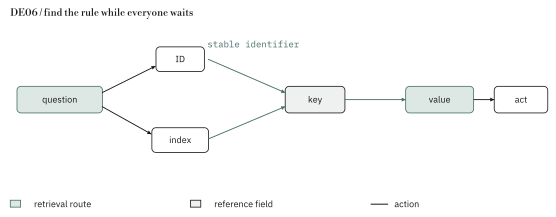
The referee looks for a door, a cost or a consequence while the rest of the table waits. A reference page needs to provide enough information to return to that conversation. Dense material can serve this task when its entry points are clear. A spacious page can make the search harder if labels sit far from their values or every paragraph carries the same visual weight. Follow the route from the question to the needed detail, including each cross-reference and physical turn of the book, to find where the search stalls.
The Art Institute of Chicago’s finding aid for Ladislav Sutnar’s collection describes his work at Sweet’s Catalog Service with research director Knud Lönberg-Holm. Its historical note identifies binder tabs, an index system and double spreads as parts of a unified approach to retrieving product information. The same finding aid records Catalog Design in 1944 and Catalog Design Progress in 1950, and lists the surviving 30 April 1942 memo announcing the catalog’s renovation. These records place the redesign across the binder, its index and the pages reached through them. [D08, digital pp. 2, 6]
B2 digital pages 19–20 assemble unequal reference regions, and digital page 34 aligns a roster without ruling every cell. C1 digital page 30 stacks reference matrices with selective horizontal rules. The module study records these different ways of grouping information for consultation outside the continuous prose sequence. A row label directs the referee toward a value; a separate region collects another kind of record. These arrangements address the same practical problem as a catalog index and its tabs: reaching a particular item within a larger body of material. [L, pp. 5, 11, 17]
For a proposed reference spread, assign a location identifier and keep it unchanged in the map, encounter key, image caption and index. Beneath that identifier, place the visible description in one region and the hidden consequence in another, with a short label for each audience. Give an exit or follow-up reference both a destination and the condition that makes it relevant. The referee can then move from the door’s current state to the next entry with the trigger still attached, including a changed route after an alarm or a newly accessible passage.
A handout separated from the book needs its own identifying mark, and a reduced map needs a readable scale. A relationship diagram needs labels that identify its rooms, routes or stages. Put the encounter identifier on each of these surfaces and trace it from the handout to the map, from the map to the key and from the key to its follow-up reference. Where the chain stops, add the missing destination beside the relevant condition so that the referee can continue the consultation from the page already open.