Module case studies · I1
Dwellers of the Forbidden City
Atlas pages 29–30
In this chapter
The city exceeds the route through it
A group can enter this city by more than one route, and the referee can let the search for an entrance become part of the adventure. The opening geography describes an enclosed rift and passages through its sides. Flying into the city brings a creature encounter, with instructions for the referee to account for those creatures afterward, while guides can bring the party directly to a chosen entrance when that better suits the session. [I1, digital pp. 3–5]
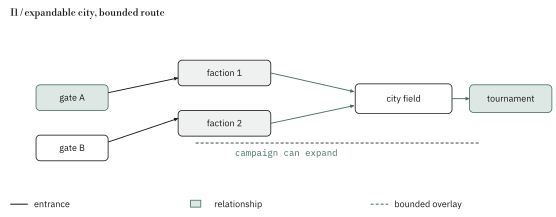
The distinction between tournament and campaign play is particularly revealing. Tournament instructions restrict the group to A1–A10 and the connecting passages, with a three-and-a-half-hour limit. The printed adventure supplies a much larger city around that route, and its later campaign section offers motives that can produce substantially different tasks. A party hired to prevent further raids might destroy the raiders, bribe them, encourage conflict between groups or obstruct access. Those alternatives are explicitly offered in the text, making the objective broader than a prescribed sequence of fights. [I1, digital pp. 4–5, 23]
The factions give those alternatives practical traction. The referee receives relationships among powerful organizers, their allies and other inhabitants, including reasons some groups may assist the party under certain conditions. A map locates the encounters, while the social account explains how strangers seeking help or starting a conflict affect the people already there. The text places these relationships before the detailed keys, giving the referee a set of interests to consult as the party moves between locations. [I1, digital p. 4]

Dwellers of the Forbidden City
A proposed city spread places an original plan beside a relationship diagram. The plan locates the entrances and destinations; the relationship diagram connects inhabitants through assistance, rivalry and obligation. A narrow overlay identifies a single-session route through the site, leaving the surrounding places and relationships visible. The referee can prepare the marked route first and use the adjacent diagram when the party’s decisions bring another group into the expedition. A changed destination then has a location on the plan and a set of affected interests beside it.
I1’s expansion pages propose rescues, rival expeditions, underground conflicts and other campaign seeds for the referee to develop. A rescue premise places prisoners across the city and gives the party a search objective. Preparing that premise requires the referee to locate the prisoners, decide who knows about them and establish ways the adventurers can obtain that knowledge. The seed supplies the motive and broad situation; those encounter and information details become part of the referee’s campaign preparation. [I1, digital pp. 23–24]